
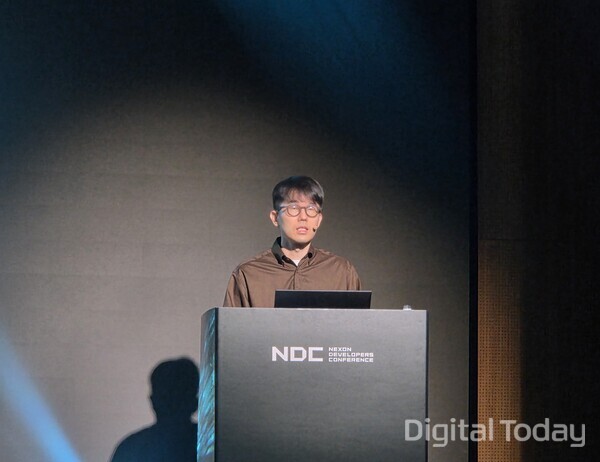
Kang Dae-hyun (강대현), co-CEO of Nexon Korea, said in a keynote at the 2026 Nexon Developers Conference (NDC 26) on June 16 that the lower the cost of implementation becomes with AI, the more the centre of competitiveness shifts from technology itself to “context”.
In the keynote, titled “In an era when implementation gets easier, what do we compete on?”, Kang assessed the current situation as an overlap of oversupply in the game industry and the spread of AI. He presented a response strategy he called “context capital (Accumulated Intelligence)”.
“The market is growing but the door to success is narrowing”... Competition intensifies even as barriers to implementation fall
Kang first laid out structural changes in the game market with figures. The number of games released on Steam rose about sevenfold in 10 years, to about 20,000 in 2025 from about 2,800 in 2015. But only 608 of them, or about 3 percent, had more than 1,000 reviews.
He also pointed to user time concentrating on existing games even as supply explodes. In 2024, 57 percent of PC and console play time was focused on games more than 6 years after release. Steam’s concurrent user count set a new record three times this year, surpassing 42 million in March, and industry-estimated revenue was also at an all-time high, but early-stage investment in games fell to the lowest level in recent years over the same period.
“The market is growing but the door to success is narrowing,” Kang said. “When AI is added, it is not only us for whom implementation gets easier. It gets equally easier for everyone.”
Kang said historical examples show that lower implementation barriers do not reduce competition. In 1865, British economist William Stanley Jevons expected coal consumption to fall as steam engines became more efficient, but coal use instead surged. As efficiency improved, industries that previously could not even consider it adopted steam engines.
The game industry followed the same pattern. As commercial engines became widespread, it was no longer possible to distinguish winners and losers by the engine itself, and the centre of competition shifted to art and content quality. As digital distribution became standard, competition shifted again, from making and selling to being discovered and chosen. That is also why branding, personalisation and marketing emerged as new areas of competition.
“In an era when implementation gets easier, the centre of gravity shifts to ‘context’,” Kang said.
“What cannot be transferred as data is the real capital”... The compounding structure of context capital
The “context” Kang described is divided into two broad layers. One is the taste and sense of judgment developers build over years and decades by digging into a genre. The other is relationships formed among users, incidents a community remembers together, and emotions that carry across generations.
He explained the difference with an example of making a MapleStory hat. If you ask a general-purpose AI to make a hat for a Maple character, it produces a hat that looks like something you could see anywhere, he said. But if you place the same order based on a style guide accumulated over 20 years and an understanding of users, it produces a hat that feels “like MapleStory”. “Context that can be transferred as data, like a style guide, will be handled better and better by AI, but the trust built by living relationships and time exchanged with users cannot be transferred with data alone,” Kang said.
He named this “context capital (Accumulated Intelligence)”. “Anyone can take and use an AI model, but context built up over time cannot be bought with money and can only be accumulated through time,” he said.
Kang said for context capital to become a real asset, it must accumulate with a compounding structure. If the experience of a previous title does not carry into the next, it remains simple interest, he said. But when in-game experiences spread to out-of-game communities and reconnect with creator content, a compounding effect emerges as interest generates interest.
He gave a dungeon boss as an example. If you only see data showing users repeatedly die to a certain boss, the conclusion would be to lower difficulty. But if you also see the community context of users sharing strategies and showing off clear videos, you can tell the boss is part of the game’s culture. “The moment you lower difficulty, it is like killing that culture with our own hands,” he said, adding that correct judgment becomes possible only when context and data are connected.
He said Roblox has grown into one of the world’s largest games, with more than 130 million daily users even after 20 years, due to the compounding accumulation of context rather than graphics. As Nexon examples, he cited an anecdote in which a couple who spent 5 years together in a live game shared their marriage news through a wedding invitation, and the case of MapleStory’s accidental 2009 “Kerning City catastrophe” continuing to be talked about as culture for more than 15 years.
Kang said context capital is not only for large studios. What creates a gap in compounding is not the size of principal but the interest rate, meaning the way it is accumulated. “The smaller the team, the faster decisions are and the closer the distance to users, allowing what you learn today to be reinvested in the game faster tomorrow,” he said.
By contrast, he said even Nexon’s 20 years of context is an asset whose value fades the moment it stops being built today. “No matter how big the principal, if it grows with simple interest it stays in place,” he said.
In closing, Kang presented AI in two categories. One is Artificial Intelligence that writes code and draws images, which is powerful but given equally to everyone, making it hard to create differences with it alone. The other is Accumulated Intelligence that compounds through time spent with users, judgment built through operations and culture created with communities.
“The first AI is everyone’s weapon, but the second AI belongs to those who recognised the true value of context,” he said. “The weapon to carry into an era when implementation gets easier is to use the first AI better than anyone, while building the second AI more deeply than anyone on top of it.”
 Ho-jeong Lee
lhj@d-today.co.kr
Ho-jeong Lee
lhj@d-today.co.kr