
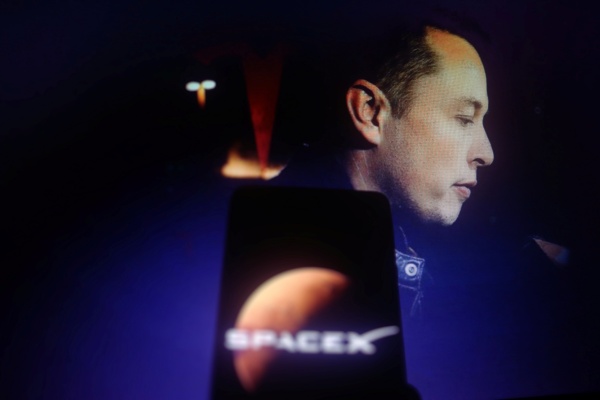
SpaceX shares rose for a second straight day after listing, pushing its market capitalisation above $2.5 trillion. The move is seen as driven by simultaneous inflows from retail investors and cryptocurrency investors after CEO Elon Musk said it could achieve $1 trillion in annual revenue by 2030.
On June 15, blockchain media outlet CryptoSlate reported that SpaceX shares traded around $170 early in the session, up about 6 percent from the previous close. They later ended at $192.46, up 19.22 percent. After a 19 percent jump on the first day of trading, the stock rose more than 42 percent above the IPO price of $135 in two days. The market value climbed above $2.5 trillion. The company also raised about $75 billion through the initial public offering, setting a record for the largest IPO on record.
Retail investors drove the early surge. Market research firm Vanda Research said retail investors bought a net $93.8 million of SpaceX shares on June 13, the first day of trading. That was the largest net retail buying on record for an IPO stock. On the same day, SpaceX accounted for about 4 percent of total retail trading value in the U.S. stock market, and its net buying was more than 3.5 times that of Nvidia.
The investment frenzy also spread to the cryptocurrency market. As trading in SpaceX-related derivatives surged, futures volume rose 140 percent to about $930 million, according to CoinGlass. Open interest also topped $540 million.
A similar trend appeared on exchanges offering tokenised stock products. Trading volume in Gate.com's SpaceX-linked token, 'SPCX', topped $100 million on the first day, far exceeding trading in the same exchange's Tesla- and Circle-related products.
Musk's long-term growth outlook fuelled market expectations. Over the weekend, Musk wrote on X, formerly Twitter, that "SpaceX can achieve $1 trillion in annual revenue by 2030" and that "it would be surprising if it does not exceed $1 trillion in 2031". The remarks were seen as setting a new growth benchmark for SpaceX's valuation, which is already highly rated.
Still, the gap between current results and the target is substantial. SpaceX's 2025 revenue is estimated at about $18.7 billion. To meet Musk's target, revenue would have to expand more than 50-fold over the next five years. That is also about three times higher than Morgan Stanley's forecast of $330 billion in revenue for 2030.
SpaceX is touting Starlink, Starshield and Starship as future growth engines. The satellite internet service Starlink is cited as its largest revenue source. Starshield, a government and defence satellite communications business, is expected to see expanding public-sector demand. The next-generation spacecraft Starship is viewed as a long-term growth pillar targeting lunar exploration, Mars development and the space logistics market. In its prospectus, the company put its total addressable market, including artificial intelligence, communications and space infrastructure, at up to $28.5 trillion.
Profitability remains a challenge. SpaceX's capital expenditure in the first quarter this year was $10.1 billion, up sharply from $4.1 billion a year earlier. That reflected investments in building AI infrastructure, developing Starship and expanding long-term space projects. The company posted a net loss of about $5 billion in 2025, and cumulative losses over recent years are estimated at about $50 billion. The prospectus also mentioned the possibility it may not achieve profitability in the future.
This has left the market divided. CFRA said a cautious approach was needed due to high growth assumptions and valuation and large capital spending. Some investors, however, believe the current valuation can be justified given the potential of Starlink and the space industry.
Swissblock macro analyst Henrik Zeberg (헨리크 제버그) argued that "the market is valuing a loss-making company at the world's top level" and that "it could become one of the biggest bubbles in history". He added that "there is still a possibility of additional sharp gains before reaching the final peak".
Wall Street price targets also vary widely. Loop Capital put it at $349, Baird at $320 and Bernstein at $310. Oppenheimer, however, set $190, and New Street Research set $165. The average target price is about $267, showing that the market is sharply split over revenue growth and whether profitability will improve.
The market sees key variables for further gains as growth in Starlink subscribers, progress in Starship development, expansion of government contracts and the results of AI infrastructure investment.
 Jinju Hong
hongjj@d-today.co.kr
Jinju Hong
hongjj@d-today.co.kr