
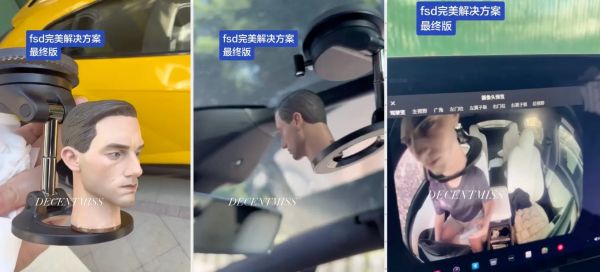
[DigitalToday AI Reporter] Tesla's driver-monitoring system can be bypassed with a small plastic doll head costing around $30, or about 45,000 won.
Foreign media including electric vehicle publication Electrek reported on June 15 that small ornaments designed to fool Tesla's interior camera are being sold on Chinese e-commerce platforms for $20 to $50, or about 30,000 to 75,000 won.
The products are sold under names such as "travel companion" or "dashboard decoration". Their real purpose is known to be tricking the interior camera into thinking the driver is watching the road while using Autopilot and Full Self-Driving (FSD). Some Tesla drivers in China are reported to have attached celebrity figurine heads near the rear-view mirror so the camera recognises a normal head position and gaze.
Tesla's driver-monitoring system uses an interior camera to track head position and eye movement to check whether the driver is watching the road. A case has been confirmed in which a forward-facing plastic head shaped like a face met those detection conditions.
In a case introduced by Digital Trends, a Model 3 owner in China used a fake head resembling Dwayne Johnson (드웨인 존슨) and was reported to have received no safety warning even once for 30 minutes. The driver was eating sunflower seeds with one hand and filming video with the other at the time.
Sellers are offering products beyond celebrity figurines, including a screen device that blinks, seat headrests and custom items that attach to dashboards. Buyer reviews indicate demand from people who want to use their phones while driving, eat food, and even try to sleep.
The problem is that such bypass attempts are not new. In the past, steering-wheel weights circulated among Tesla drivers to trick the torque sensor into thinking the driver was holding the wheel. The U.S. National Highway Traffic Safety Administration (NHTSA) demanded a halt to sales of "Autopilot Buddy", but similar products continued to appear afterward.
Tesla later expanded its interior camera-based monitoring functions, but what was seen as a more sophisticated system has now been bypassed by a cheap plastic toy.
The timing is also sensitive. Tesla recently launched FSD in China, but it is facing a fraud lawsuit related to Full Self-Driving from 10 local owners. It is also moving to address more than 100,000 vehicles that used hacked FSD activation devices in countries where the software was not approved.
Autopilot and FSD are Level 2 driver-assistance systems, not fully autonomous driving, meaning drivers must always monitor road conditions and be able to intervene immediately. NHTSA confirmed 80 cases of traffic-law violations linked to FSD, including running signals and entering opposing lanes, and escalated an ongoing investigation covering about 3.2 million vehicles to the engineering analysis stage.
 Seung-a Yoo
ysah@d-today.co.kr
Seung-a Yoo
ysah@d-today.co.kr