
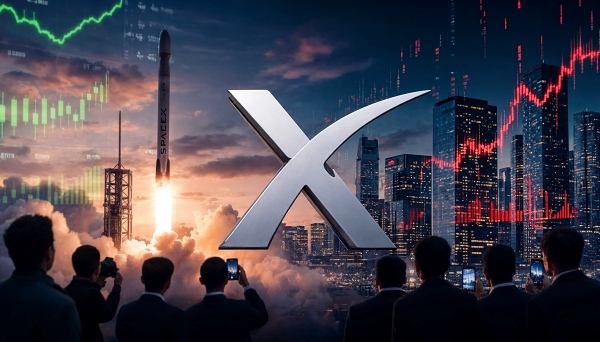
SpaceX completed what was described as the largest initial public offering, raising $75 billion.
On June 15, IT outlet TechCrunch reported that SpaceX offered 555.6 million shares at $135 each and entered Nasdaq. The listing pushed Elon Musk's wealth above $1 trillion, making him the world's first trillionaire.
The stock stayed strong after the listing. SpaceX began trading at $150 on Nasdaq on June 12, up 11% from the offering price. The intraday gain widened to as much as 30%, and it closed at $160.95, up 19%. On its first full trading day, it rose as high as $186.15 at one point in the afternoon, extending gains of more than 15%. Robinhood said historic traffic occurred on its trading platform for several hours after SpaceX's historic market debut.
The listing also drew attention for governance. According to SpaceX's S-1 filing, Musk holds about 85.1% of voting rights. The structure concentrates control of the company effectively in Musk even after the listing. After the stock rose, Musk said on X, formerly Twitter, that he loves SpaceX employees more than words can describe.
Investment banks also saw sizable benefits from the listing. The Wall Street Journal reported total fees were estimated at about $500 million, and insiders and employees are expected to receive significant compensation. The New York Times estimated 4,400 SpaceX employees could become millionaires.
Financial burdens remain a variable. SpaceX generated more than $18 billion in revenue in 2025 but posted a net loss of $4.9 billion. Cumulative losses since its founding exceeded $37 billion. While expectations for growth remain centered on Starlink satellite internet, investors need to watch whether profitability improves given the burden of large deficits.
Large contracts secured ahead of the listing are also in focus. SpaceX signed a series of contracts to sell computing resources to improve its financial position. Anthropic agreed to pay SpaceX $1.25 billion a month, and Google agreed to pay $920 million a month. Google said it was a short-term contract to meet demand for its recently launched artificial intelligence products.
In its outlook, the Starship rocket and AI are cited as key pillars. In listing documents, SpaceX presented business opportunities linked to Starship reusability and xAI alongside its current revenue structure centered on Starlink. The documents also showed that the path to reusability for Starship remains uncertain, and it is unclear whether the large-loss structure will be resolved in the short term.
The listing documents also added language warning of potential future dilution. This was seen as leaving room for additional fundraising or changes in the ownership structure after the listing.
The possibility of a merger with Tesla is also drawing market attention. Gwynne Shotwell (그윈 쇼트웰), SpaceX's chief operating officer, said in a June 12 CNBC interview, when asked about it, that a merger of SpaceX and Tesla could make Musk's life a little more comfortable. After the remarks, market speculation resurfaced about a possible combination of the two companies.
Ultimately, SpaceX's listing does not end with the record of the largest IPO. Strong initial demand, Musk's overwhelming control, a revenue structure centered on Starlink, AI computing contracts, the possibility of additional dilution and merger speculation with Tesla remain variables that could influence the stock price and corporate value after the listing.
 Yoonseo Lee
yslee@d-today.co.kr
Yoonseo Lee
yslee@d-today.co.kr