
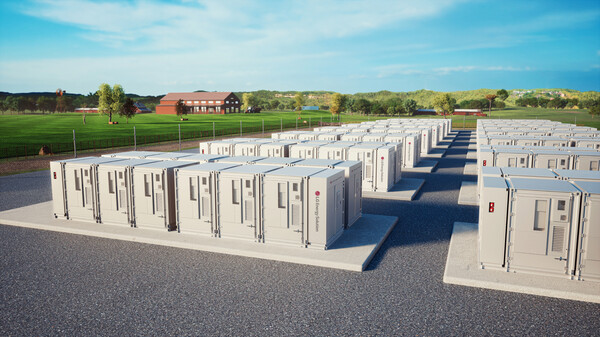
The fallout from slowing electric vehicle demand is spreading to the energy storage system (ESS) market. As stalled EV battery lines are switched to ESS, the production capacity of South Korea's three battery makers is growing at more than twice the pace of what the market can absorb. Expansions are being driven by efforts to defend utilisation rates rather than demand.
Industry estimates on June 16 showed that the increase in ESS production capacity this year at South Korea's three battery cell makers — LG Energy Solution, Samsung SDI and SK On — is expected to reach about 109 GWh. Actual shipment growth in the market is expected to come in below 50 GWh. That means capacity is expanding at more than twice the pace the market is taking volume.
That can be interpreted as only about half of the additional 109 GWh translating into actual sales, while the rest remains without a destination. The excess ultimately builds into inventories or leads to lower factory utilisation. Since the starting point for expansion was not demand forecasting, the balance of views tilts toward the gap widening rather than narrowing.
In practice, this expansion is far from investment based on a forecast that ESS demand will rise. As global EV sales lose momentum and utilisation falls at EV battery plants, manufacturers have turned the same facilities to ESS to avoid leaving factories idle. Supply is rising first regardless of what the market can actually absorb.
The same signal is being picked up in the United States, the main market for the South Korean trio. A report by the American Clean Power Association's Energy Storage Council estimated annual U.S. ESS project demand at 60 GWh this year, while total production capacity — including current operating capacity plus additions planned by year-end — was tallied at 146 GWh. Assuming all facilities start up on time, supply would exceed demand by about 86 GWh.
The 86 GWh gap, however, is based on the assumption that all factories run at 100 percent. The actual surplus could be smaller. Intertek CEA analysis showed that, based on announced capacity, the United States in 2026 is expected to have about a 10 percent capacity surplus that meets the Foreign Entity of Concern (FEOC) compliance criteria, with South Korean suppliers accounting for more than 80 percent of that compliant volume. Since South Korean EV battery plants have historically shown 70 to 80 percent utilisation, the actual surplus depends on how quickly South Korean companies ramp up their facilities.
Installation trends show demand is continuing to grow. Hana Securities said global new ESS installations in April rose 18 percent from a year earlier to 17.7 GWh. Of that, power grid installations connected to power plants or transmission networks rose 27 percent to 12.8 GWh, leading the growth, while installations directly at demand sites such as homes or factories were 4.9 GWh, roughly in line with a year earlier. Cumulative installations from January to April rose 31 percent to 88.1 GWh, with grid use up 40 percent to 66.4 GWh.
Concerns are rising because the centre of that growth is concentrated in China. New installations in China in April rose 55 percent to 9.4 GWh, accounting for more than half of the global total. Chinese companies such as CATL and BYD are leading ESS expansions based on lithium iron phosphate (LFP) batteries, which are relatively cheaper, and are leaning on price competitiveness. With an added trend of redirecting volumes that cannot be absorbed domestically into exports, global surplus inventories are also building.
By contrast, the United States, the main market for the South Korean trio, saw a contraction. New U.S. installations in April plunged 67 percent from a year earlier to 1.1 GWh, and grid use fell 86 percent to 0.4 GWh. On a cumulative basis, installations rose 11 percent to 12.4 GWh, but the monthly trend is showing a signal of slowing. That contrasts with Europe, which posted a 39 percent increase in April to 1.6 GWh and a 68 percent rise in cumulative terms to 10.2 GWh over the same period.
EV-to-ESS line shifts create 'expansion without demand'
Over a longer horizon, the view that the ESS market trends upward remains valid. But analysis suggests the period around this year marks an entry into a phase where unit-price competition and restructuring within the supply chain are unavoidable. The key is whether the three South Korean makers can pursue a strategy of offsetting weak EV demand with ESS while preserving profitability.
With Chinese batteries blocked from entering by the U.S. Inflation Reduction Act (IRA) and FEOC rules, the three South Korean makers are focusing on the U.S. ESS market. There is also an expectation that South Korean companies will take a large share of U.S. supply as a regulatory windfall. But there is concern that if the redirected volume from South Korean companies itself exceeds U.S. demand, it could turn into unit-price competition among South Korean firms.
Profitability is also a variable. If production capacity exceeds demand by a wide margin, battery plants continue to incur fixed costs even if operations stop, giving manufacturers a stronger incentive to push volume into the market even by lowering unit prices. An industry official said, "It is highly likely that push sales to protect utilisation rates will intensify."
 Daegeon Seok
d2dg@d-today.co.kr
Daegeon Seok
d2dg@d-today.co.kr