
South Korea's national soccer team won its first match of the 2026 FIFA World Cup in North America, and attention is also on the artificial intelligence technology used in the stadium. Semi-automated offside technology (SAOT), a key topic at the Qatar World Cup 4 years ago, has become more sophisticated, and AI-based match analysis tools have also newly emerged.
The most prominent technology at this World Cup is the upgraded SAOT. SAOT supports offside decisions by analysing data collected by tracking cameras installed in the stadium and a sensor inside the official match ball. Sixteen dedicated cameras inside the stadium track the positions of the ball and players more than 50 times per second. The cameras use optical tracking technology from Hawk-Eye Innovations. They collect movements of players and the ball in real time and reconstruct match scenes in 3D.
The speed of information delivery has also increased. At the 2022 Qatar World Cup, when SAOT detected a possible offside, the information was sent to the video assistant referee (VAR). At the North America World Cup, if it is judged a clear offside, the information is sent directly to the assistant referee in the stadium. That allows the assistant referee to raise the flag faster, reducing decision time. It also lowers the risk of clashes and injuries that can occur if play continues after an offside.
◆Combining match ball, cameras and 3D avatars raises SAOT precision
The official match ball, "Trionda", also supports decision accuracy. An inertial measurement unit (IMU) sensor inside the ball transmits in real time the moment it is kicked and its movement. Combined with player position data, it determines whether an attacker was in an offside position at the moment of the pass. The ball sensor can also capture when it touches a player's hand or arm, and can be used for handball and penalty decisions. Combining ball movement and contact timing with player position data helps secure more detailed information needed for decisions.
3D avatars digitally representing players have also been introduced. FIFA, working with Lenovo, scanned the bodies of participating players and created 3D avatars reflecting their actual body shapes. The avatars are used to accurately distinguish specific players and body parts when multiple players overlap or move quickly. After a decision, broadcast screens provide 3D graphics similar to the real players, showing intuitively which body part, such as a shoulder or toe, crossed the offside line.
Still, the technology's limitations surfaced from early in the tournament. In a group-stage match between Switzerland and Qatar, an offside was suspected in the move that led to Switzerland winning a penalty, but SAOT's 3D decision graphic did not appear on the broadcast. FIFA said it could not generate an onside animation due to a temporary technical failure. It said the VAR review itself proceeded normally, and the attacker was onside on the review line. But controversy arose after FIFA disclosed the review screen only after the match ended.
◆AI extends to tactical analysis; match data used in natural language
AI is being used not only for refereeing decisions but also for tactical analysis by participating countries. Football AI Pro, a generative AI-based match analysis tool developed by FIFA and Lenovo, is being provided to 48 teams. Previously, when FIFA provided match data reports to each national team, performance analysts had to interpret them directly. With Football AI Pro, analysts can ask questions in natural language to examine an opponent's tactics, player movement and match patterns that appear in specific situations.
For example, they can ask where a specific player most often received the ball, or which routes the opposing team used during attacking transitions, and then check the relevant scenes and data. Analysis results are provided in text, video, graphs and 3D visualisations.
FIFA aims to narrow gaps in data use between teams by providing the same analysis tool to countries that find it difficult to run large-scale specialist analysis staff. For coaching staff, it reduces the time spent replaying multiple match videos and allows faster checks of needed scenes.
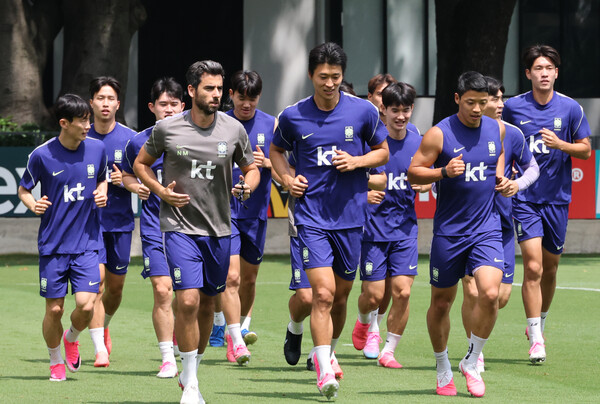
South Korea, coached by Myung-bo Hong (홍명보), came from behind to beat the Czech Republic 2-1 in its Group A opener. Hwang In-beom and Hyun-gyu Oh scored in quick succession to secure the team's first win of the tournament. At 10 a.m. on June 19, South Korea plays host Mexico in Guadalajara in its second Group A match.
 Jin-ho Lee
jhlee26@d-today.co.kr
Jin-ho Lee
jhlee26@d-today.co.kr