
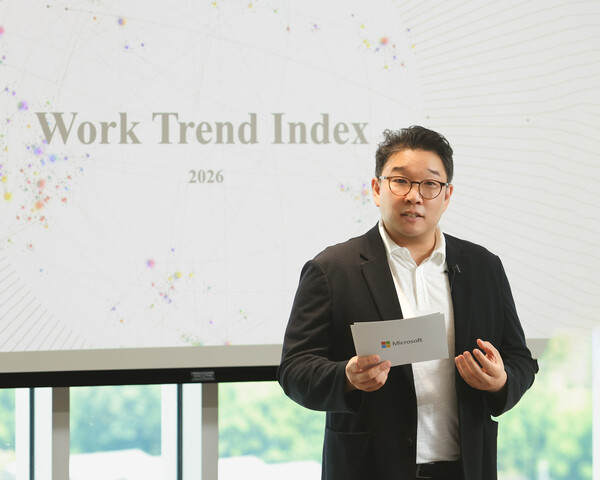
Microsoft released its annual 2026 Work Trend Index report, which analyses how corporate users work with AI.
The report showed 19 percent of companies were in a frontier stage where both individuals and organisations were ready. Half, or 50 percent, were in transition. By contrast, 16 percent were in a stagnation stage where neither individuals nor organisations were ready.
The report also identified 2 traits among frontier-stage expert users. One was that they deliberately define the division of roles between AI and humans before starting work. The other was that even if they make extensive use of AI, they secure some time to work without AI.
Among frontier experts, 53 percent said they set the division of roles between AI and humans in advance. The share saying they deliberately work without AI for a set period reached 43 percent. Among general respondents, 30 percent said they make time to work without AI, while 33 percent said they distinguish between AI and human roles.
South Korea showed a similar pattern. Among frontier experts and general respondents, those saying they perform some tasks without AI were 31 percent and 22 percent, respectively. Those saying they distinguish between AI and human roles were tallied at 48 percent and 34 percent.
Based on this, the report stressed that deliberate effort is needed in the process of finding a balance between what to delegate to AI and what humans should do.
The report said as AI moves beyond simple assistance and participates directly in work flows, the way people work is being reshaped into a form that combines humans, agents and systems. As a result, it said the challenges leaders must solve are shifting from simple technology adoption to redesigning work processes.
It said employees should use AI to move into higher value-added work, leaders should focus on work redesign rather than adoption, and organisations should shift into a learning system that reflects on-the-job learning in operations.
The report also pointed out that the spread of AI and agents may not lead to performance. It said organisational competitiveness depends not on the speed of adoption, but on the ability to turn on-the-job learning into shareable routines and embed AI in actual operations through absorption.
The report said that as AI-use maturity rises, AI use tends to concentrate on cognitive tasks. Based on an analysis of more than 100,000 cases of Microsoft 365 Copilot usage data and patterns, 49 percent of all conversations supported tasks such as information analysis, problem solving, evaluating alternatives and creative thinking. Collaboration and communication accounted for 19 percent, followed by information search at 15 percent and document and deliverable writing at 17 percent.
As AI use increased, human judgement became more important. Among global respondents, 50 percent said quality control of AI output was important, and 46 percent cited critical thinking as a core capability. It also said 86 percent viewed AI output as a starting point rather than a final answer, and thought responsibility for results rests with humans.
The report also confirmed that organisational environment has twice the impact of individuals. It said individual employee mindset and behaviour matter, but organisational culture, manager attitudes and talent policies have a larger influence on AI performance. In terms of organisational culture, it cited a 분위기 that recognises AI as a strategic advantage and encourages experiments as key.
Sung-mi Oh (오성미), AI Workforce GTM director at Korea Microsoft, said, "The leader group must use AI directly, discuss output quality standards with the team, and provide psychological safety that allows failure. But only 26 percent of employees said that in reality the leader group’s will and execution are being clearly conveyed down to the team level."
Oh also said, "When building an AI agent, it is almost never the case that the first output is immediately deployed into the actual operating environment. What we see most often is that it takes about 3 rounds of revision and deployment before it goes into the real operating environment," adding, "That is why an organisational culture that accepts failure as part of the process is needed."
The report also stressed that for AI use to translate into real performance, leaders must fundamentally redesign operating models and processes, going beyond simple technology adoption. It said this means overhauling work flows, evaluation methods and compensation systems that remain stuck in existing ways to fit new ways of working.
In the execution stage, middle managers emerged as playing a key role. It said results from a separate survey of 1,800 people globally showed that key indicators rose across the board when managers demonstrated AI use directly.
Won-woo Cho (조원우), head of Korea Microsoft, said, "This report shows that changes around AI are happening simultaneously across 3 axes: employees, leaders and organisations, and that the more AI takes on execution, the more important human judgement and leadership become." He added, "Domestic companies are also moving beyond AI adoption to innovate work methods and collaboration structures, and are stepping up preparations in earnest to connect this to actual work and performance."
 Chi-gyu Hwang
delight@d-today.co.kr
Chi-gyu Hwang
delight@d-today.co.kr