
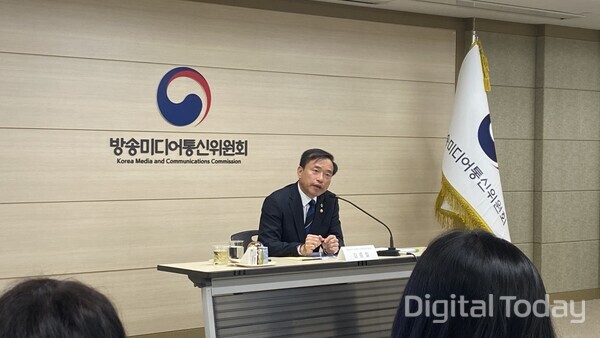
The Broadcasting Media Communications Commission will push in earnest to set up a Media Development Committee under the prime minister.
Chairman Kim Jong-cheol (김종철) of the Broadcasting Media Communications Commission said at a news conference on June 15 at the Government Complex in Gwacheon marking the government's first anniversary and his six months in office that he will make the committee's launch the starting point for a major shift in media policy. He said it will be pursued as a key task in the second half of the year as it is a state agenda item.
The committee is a public-private panel pursued as a state agenda item of the People’s Sovereignty Government. It will pursue policy tasks including improving advertising and programming regulations, supporting K-platforms' overseas expansion and introducing artificial intelligence (AI) across the entire broadcasting and media process, with the goal of building a future-oriented digital and media ecosystem.
Setting up the committee is seen as a prerequisite for long-stalled media issues such as restructuring the Broadcasting Development Fund and pushing an integrated media law. There has been widespread criticism that those issues have failed to gain momentum because policy authority is split among ministries including the Broadcasting Media Communications Commission, the Ministry of Science and ICT and the Ministry of Culture, Sports and Tourism. The plan is to address this by establishing a control tower under the Office of the Prime Minister.
The work is at an early stage. The commission is leading the effort and is working with the Office for Government Policy Coordination on related tasks. After its launch, related ministries, including the Ministry of Science and ICT and the culture ministry, are expected to be involved, along with the Ministry of Economy and Finance, which is needed for changes to broadcasting funding.
Kim said the need for the committee stems from the fact that issues in the broadcasting industry are interconnected and require both micro and macro approaches. He said he will work to ensure that, through the committee, regulation and promotion policies are discussed comprehensively, including the legal and institutional foundation such as an integrated media law and the funding structure of the broadcasting and media sector.
The commission also plans to step up promotion policies with the committee as the starting point.
It will pursue media sovereignty under a new vision of implementing a basic media society. It is discussing measures such as providing OTT subscription vouchers to vulnerable groups.
It also flagged plans to set up a transparency centre for fact-checking and responding to disinformation. The centre would comprehensively support voluntary fact-checking activities, and a legal foundation is already in place with the enforcement of an amendment to the Information and Communications Network Act, known as the law to eradicate false and manipulated information.
It is also pushing to expand media and AI competency education by life stage. The plan is to broaden education to all age groups, including how to use AI and how to prevent adverse effects.
The commission also cited the establishment of a Broadcasting Media Communications Promotion Agency and easing regulations on broadcast advertising and programming as key promotion policies. Kim said promotion and regulation are not in conflict but complementary, adding that bad regulation suppresses promotion while good regulation instead encourages it.
Principled response on public broadcaster, big tech regulation; JTBC re-approval variable
On regulatory issues, the commission's stance is to prioritise voluntary resolution rather than direct intervention, but to respond firmly if illegal conditions persist.
On delays in follow-up steps for normalising governance structures at public broadcasters stemming from revisions to three broadcasting laws, it flagged legal and political responsibility. At KBS, the process has been halted after a union filed an injunction request over forming a programming committee. The target deadline set by the commission for recommending public broadcaster directors is June 26.
On JTBC's liquidity crisis, Kim stressed it could affect the re-approval process. He said it is currently assessed to be at the level of a liquidity crisis that does not immediately affect the broadcasting business itself. He added that because financial and technical assessments are included as key items in re-approval reviews that were delayed during the commission's vacancy period, the situation could directly affect the evaluation.
Procedures to impose penalty surcharges over Google's and Apple's forced in-app payment practices will also be stepped up. Given strong civil society interest, the commission has already begun a review considering urgency and seriousness and plans to soon move to formal procedures. It has completed a fact-finding probe into issues surrounding Coupang's so-called kidnapping ads and cancellation restrictions and is preparing to begin the process for a committee resolution.
Kim urged parliament to promptly recommend standing commissioners so the consensus-based commission can be fully constituted. He said holding 17 full commission meetings and handling 98 agenda items in just two months of full operation was possible because four non-standing commissioners actively participated while sacrificing personal schedules. He stressed that parliament should swiftly recommend the remaining standing commissioners so the commission can operate as a full team.
 Seulgi Son
sageson@d-today.co.kr
Seulgi Son
sageson@d-today.co.kr