
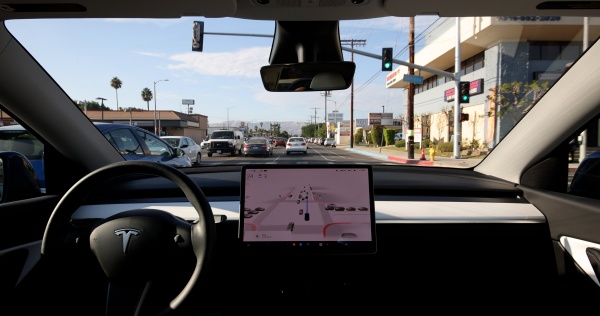
Tesla's latest autonomous driving software, Full Self-Driving (FSD) V14, has expanded functions to the point of handling everything from departure to parking after arrival, but it still has tasks to improve in areas such as map accuracy and parking decisions, it showed.
Cleantechnica, an electric vehicle-focused outlet, reported on June 13 that a user who drove a 2026 Tesla Model Y for about two weeks assessed that HW4-based FSD V14 greatly reduced the frequency of interventions compared with HW3-based FSD V12, but navigation errors and parking problems still occurred.
The user explained that after driving a 2019 Model 3 for about 7 years and experiencing multiple FSD updates, upgrades stopped at FSD V12 because of HW3 hardware limits. By contrast, HW4 vehicles produced since 2023 support FSD V14 based on improved computing performance and camera systems.
He said, "Now I almost never disengage FSD," adding that the process of fully stopping at stop signs and then setting off had become more natural. He also added that he had not experienced situations in which the car failed to recognize other vehicles at intersections.
The biggest change in FSD V14 was cited as automation of the start and end segments of driving. When the user entered a destination by voice or text, the vehicle set its own route and traveled to the destination. It also successfully performed actions such as backing out of a garage and entering the road, or exiting a parking space, on multiple occasions, he explained. After arrival, it attempted to park on the roadside or in a parking lot on its own, and he said it could stop the vehicle in an appropriate position on a home driveway.
In public parking lots, it still showed limits. The vehicle could not recognize or designate disabled parking spaces, and it could not choose an optimal parking space closest to a store or office. At a Costco store in Wisconsin, in particular, it could not find a parking space, and the user pointed out that the site was still marked as green space on Google Maps used by Tesla navigation.
Address recognition errors also occurred. Even when entering a home address, there were cases in which it guided to a house on a different street, and he explained that he had to manually adjust the pin location on the map to move to the correct position.
Route judgement errors were also reported. When departing Rhinelander-Oneida County Airport in Wisconsin, the vehicle tried to enter a one-way road in the wrong direction, and in some parking lots there were cases in which the vehicle chose a right turn even though navigation instructed a left turn. Lane selection problems also did not appear to be fully resolved. The user said some lane-selection errors seen in the previous FSD V12 were also reported in V14.
The cause of these problems was cited as limitations in location information and map data. The user analyzed that GPS position accuracy could have an error of about 15 feet, or about 4.5 meters, and that map information is also not always up to date, making precise parking or route judgement difficult.
On the hardware side, improvements were also confirmed. Under the previous FSD V12, fitting a rear bicycle rack often led the system to judge that the rear camera was blocked and to limit operation. But he said FSD V14 maintained autonomous driving functions even in the same environment.
Complaints were also raised about the pricing policy. Currently, new Tesla vehicles cannot use lane keeping and steering assist functions unless they pay a monthly FSD subscription fee of $99, and by default they provide only traffic-aware cruise control. The user pointed out that this was "a structure that effectively induces FSD subscriptions even for drivers who only want to use steering assist on highways."
Remaining tasks were cited as slowing to match flashing signals in school zones, garage parking, designating specific parking spaces, recognizing disabled parking areas, choosing drive-through lanes, and dealing with speed bumps and sections with deep drainage ditches.
Handling of severe weather was also cited as a limitation. Tesla is currently removing radar and relying on a camera-based vision system. The user assessed that in conditions of torrential rain or heavy snow, where visibility is severely limited, it would be difficult for FSD to operate normally.
In the end, the point the industry is watching is whether FSD can go beyond a supervised assistance system to record fewer mistakes and a lower accident rate than humans. The user said, "Only when FSD reaches a level with fewer mistakes and fewer accidents than human drivers can it be assessed as Level 4 autonomous driving that does not require supervision."
Tesla's HW4 and FSD V14 expanded the scope of autonomous driving from departure to parking after arrival and raised perceived performance, but tasks remain for reaching full autonomy, including map accuracy, parking decisions and severe weather response, the assessment said.
 Jinju Hong
hongjj@d-today.co.kr
Jinju Hong
hongjj@d-today.co.kr