
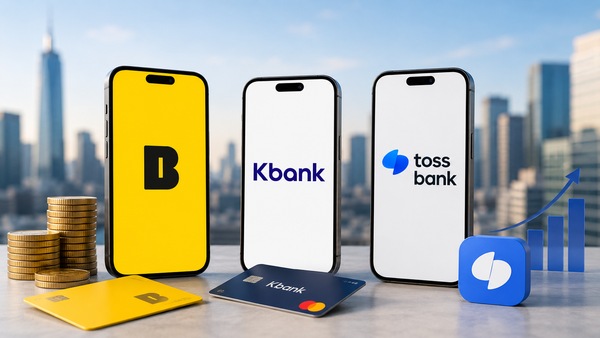
The combined customer base of South Korea's three online-only banks - KakaoBank, K Bank and Toss Bank - has exceeded 58 million and is approaching 60 million. They expanded their customer bases on the back of mobile financial services and day-to-day services. But a larger customer base does not necessarily translate into stable profitability, and diversifying revenue sources is emerging as a key task in the second half.
As of the end of the first quarter, the three online-only banks had a combined 58.21 million customers, the financial industry said on June 15. Given that Toss Bank exceeded 15 million customers as of the end of April, their combined customer base appears to have entered the mid-58 million range.
KakaoBank had 27.27 million customers at the end of the first quarter, up 570,000 in three months. Its customer base is also expanding across all age groups. It said 80 percent of people in their 40s and 62 percent of those in their 50s use KakaoBank. Penetration among minors under 20 also rose to 31 percent.
Engagement metrics also improved. KakaoBank's first-quarter MAU stood at 20.32 million and its WAU at 15.02 million, both record highs. Users of its conversational AI service, launched in May last year, also exceeded 5 million within a year of release. This is seen as the result of combining key functions such as financial calculations, transfers and checking financial information with AI to broaden customer touchpoints.
KakaoBank plans to expand its product lineup and enter non-banking areas in the second half. It is preparing to launch a so-called "stealth account" to help customers manage idle funds efficiently. It is also reviewing the acquisition of a capital company to strengthen corporate finance and enter non-bank credit markets such as leasing and installment financing. It recently expanded touchpoints with external platforms by enabling users to search for individual business owners' real estate-backed loans through Naver Pay's loan comparison service.
It is also preparing services to attract new customer groups. KakaoBank plans to roll out non-face-to-face financial services for foreign residents in South Korea in the third quarter. It plans to expand its lineup with a general-purpose debit card offering new benefits and new products aimed at teenagers and foreign customers.
K Bank is also accelerating efforts to expand its customer base. K Bank had 16.07 million customers at the end of the first quarter, up 540,000 over three months. Cooperation with Musinsa is seen as a key growth driver in the second half.
Musinsa plans to launch a "Musinsa Money K Bank account and debit card" with K Bank next month. The product is designed to link Musinsa Money, a prepaid top-up balance, with a K Bank account to enable real-time top-ups and balance checks. They are also discussing a structure that would provide benefits, including Musinsa Money, based on card usage performance.
For K Bank, the partnership with Musinsa can help it secure additional younger customers. With Musinsa planning to launch card services for other platforms such as 29CM and Soldout, interest in platform-based financial products is expected to continue.
It also plans to broaden customer touchpoints and strengthen its non-interest income base through partnerships with various app-tech and affiliate services in the second half.
Toss Bank had 14.87 million customers at the end of the first quarter, up 19.3 percent from 12.47 million a year earlier. It surpassed 15 million customers at the end of April. Platform engagement is also increasing. Toss Bank's MAU rose to 11 million at the end of May from 10.2 million at the end of March. With customer inflows and app engagement improving together, its platform competitiveness is also strengthening.
Based on its full license for the financial investment business, Toss Bank is expected to expand its bank services beyond deposits and loans into investment and wealth management through fund sales in the second half. It expects that comparison and linkage experience built through its existing "growing a lump sum" service will extend into its own sales channel. Combined with plans to launch mortgage loans, it is expected to pursue a strategy to expand both its credit portfolio and non-interest revenue sources.
The three online-only banks now face the task of strengthening fundamentals after growth in scale. As financial authorities continue to call for a stronger role in inclusive finance, the burden has also grown to manage asset quality while keeping a stable supply of loans to mid- to low-credit borrowers.
In the first quarter, all three banks exceeded financial authorities' targets for the share of loans to mid- to low-credit borrowers. KakaoBank's outstanding loan balance share and new lending share to such borrowers were 32.3 percent and 45.6 percent, respectively, above its targets. K Bank posted 31.9 percent and 33.6 percent, while Toss Bank recorded 34.7 percent and 34.4 percent. New lending to mid- to low-credit borrowers by the three banks in the first quarter totalled 1.2524 trillion won, up 3.5 percent from 1.2095 trillion won a year earlier.
Asset quality trends differed by bank. KakaoBank's first-quarter delinquency ratio was 0.51 percent, up 0.01 percentage point from a year earlier. K Bank's delinquency ratio fell to 0.61 percent from 0.66 percent, while Toss Bank's ratio was 1.07 percent, down 0.19 percentage point from a year earlier.
With high interest rates and economic uncertainty persisting, the need to expand lending to mid- to low-credit borrowers could be a burden for online-only banks. They need to translate growth in customers and traffic into profitability while also balancing their inclusive finance role and risk management.
As a result, the financial industry expects the focus of competition among online-only banks in the second half to shift from simply expanding customer numbers to diversifying products, broadening partnerships and managing asset quality. It is seen as the point when the three banks need to prove the next stage of growth in scale, based on their 58 million-customer base.
A financial industry official said, "Online-only banks have now entered a stage where they must prove a substantive role within the financial sector beyond expanding their customer base." The official said, "With the simultaneous demands of expanding inclusive finance, managing asset quality and generating non-interest income, responsibilities are also growing in line with the larger customer base."
 Ji-young Lee
ljy@d-today.co.kr
Ji-young Lee
ljy@d-today.co.kr