
South Korean stocks are expected to look for direction this week as investors weigh expectations for U.S.-Iran peace talks and the outcome of the June meeting of the U.S. Federal Open Market Committee (FOMC). Volatility was heavy last week, with circuit breakers and sidecars alternating. Sentiment partly recovered late in the week as expectations grew for easing geopolitical tensions.
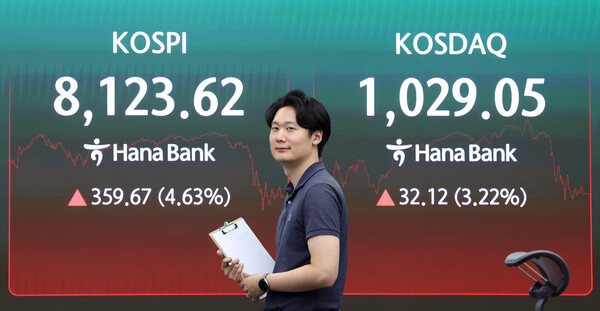
South Korean stocks rebounded sharply on June 12. The KOSPI closed at 8,123.62, up 4.63 percent from the previous session, and the KOSDAQ ended up 3.22 percent at 1,029.05. Risk appetite recovered as the possibility of an agreement between the United States and Iran came into focus.
U.S. stocks also rebounded in the latest session. As expectations rose for U.S.-Iran talks, the Standard & Poor's 500 index rose 1.8 percent and the Nasdaq climbed 2.5 percent. The Philadelphia Semiconductor Index jumped 7.9 percent. Oil prices, interest rates and the dollar fell together, easing some of the pressure that had weighed on stocks.
Volatility has not disappeared completely. Sidecars have been triggered 25 times on the KOSPI so far this year, the most since the 2008 global financial crisis. The KOSPI 200 Volatility Index (VKOSPI), known as Korea's fear gauge, also rose to as high as 91.23 at one point, a record level. It suggests the market is repeatedly swinging between sharp gains and steep losses.
Foreign flows are also still difficult to take comfort in. Foreign investors posted net selling on the KOSPI for 24 straight sessions since May 7, the fourth-longest streak on record. They turned to net buying on June 12, but whether that will continue needs further confirmation. Another variable is that retail investors have increased margin loans and unsettled trades to absorb foreign selling, raising the risk of forced selling if the index is shaken again.
The most important event this week is the FOMC. The result is expected on June 17 local time, or early June 18 in South Korea. The market is leaning toward a rate hold, but investor sentiment could shift sharply depending on the message at the news conference. Recent U.S. employment and inflation data have come in stronger than expected, increasing uncertainty over monetary policy.
The industry sees the FOMC as potentially becoming a catalyst to reduce uncertainty. With markets already reflecting much of the rate burden, an analysis suggests relief buying could come in if the Fed does not deliver an excessively hawkish message. Whether clues emerge on the future direction of monetary policy is especially important.
The U.S.-Iran negotiations also need to be watched. Oil prices fell and U.S. Treasury yields and the dollar steadied after U.S. President Donald Trump mentioned the possibility of an agreement with Iran.
If talks are concluded, stabilising oil prices could ease inflation pressures. That could reduce upward pressure on interest rates and be favourable for growth stocks and semiconductor shares.
If negotiations falter again, markets could increase volatility once more. If concerns re-emerge over the Strait of Hormuz and crude supply, oil prices would rise and that would feed into inflation and rate burdens. With stocks having recently been sensitive to interest rates and oil prices, intraday swings could widen depending on news related to the negotiations.
By sector, there is a need to focus on the possibility of rotation. An assessment has emerged that, after a recent correction, chemicals, energy, steel, machinery, securities, construction, shipbuilding, nonferrous and timber, and trading and capital goods have moved into undervalued territory relative to earnings. In the short term, it appears effective to look at sectors that have risen less relative to earnings rather than tracking only semiconductors.
The second-quarter earnings season is also a factor that will determine the next direction. Starting with Samsung Electronics' preliminary earnings release in early next month, whether second-quarter earnings forecasts are revised higher is expected to be checked in earnest. Semiconductors, autos, secondary batteries, power equipment, shipbuilding and defence are being cited as sectors where valuation burdens have fallen again relative to earnings after the recent correction.
Ultimately, the market next week is expected to be a process of passing through two variables: the FOMC and the U.S.-Iran negotiations. If the talks are actually concluded and the Fed's message does not deviate from the market's expected range, the KOSPI could try to resume an upward trend. If rate burdens rise again or oil prices rebound, volatile trading is likely to continue.
Lee Kyung-min (이경민), a researcher at Daishin Securities, said, "Additional fluctuations should be factored in depending on the June FOMC outcome next week, but we expect an upward trend to resume from that point," adding, "Upward revisions to earnings forecasts will raise upward pressure on the KOSPI and expand upside potential."
 Sangyeop Oh
yub@d-today.co.kr
Sangyeop Oh
yub@d-today.co.kr