
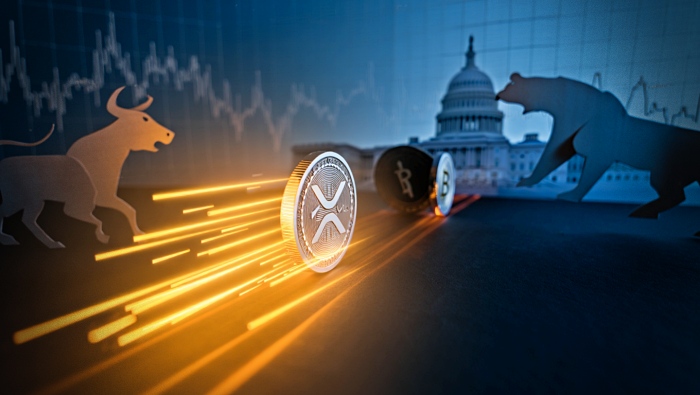
[DigitalToday reporter Hyunwoo Choo] In the first week of June, the crypto market revolved around three pillars: “XRP’s solo run,” “bitcoin’s silence,” and a clash of forces over the U.S. Clarity Act. Spot bitcoin ETFs saw funds leave for 10 straight sessions, with cumulative net outflows nearing $3 billion. Over the same period, XRP ETFs alone extended a streak of net inflows, creating an unusual contrast. JPMorgan, the largest U.S. bank, also publicly opposed the Clarity Act, adding a new variable on the legislative front.
• XRP ETF ranks No. 1 for crypto ETF inflows; bitcoin and ether outflows persist • Morgan Stanley discloses first XRP ETF holding; investment totals $15,488 • There is a separate condition for a surge in XRP; “bank demand” matters more than retail buying • Ripple “supports payments, custody and tokenisation”; expands enterprise crypto infrastructure
XRP exchange-traded funds (ETFs) are showing an unusual presence in the crypto ETF market. On May 29 (local time), XRP ETFs recorded net inflows of $11.88 million. Bitcoin and Ethereum ETFs saw outflows of $125.31 million and $17.91 million, respectively, on the same day. Based on Sosovalue data, cumulative net inflows into XRP ETFs topped $1.42 billion, setting a record of net inflows for 16 straight sessions since April 30.
Wall Street’s attention also turned to XRP. Morgan Stanley disclosed for the first time that it holds XRP ETFs. The investment totals $15,488, and the amount itself is not large. Still, analysts say the fact that Morgan Stanley, one of the world’s largest investment banks, officially added XRP ETFs to its portfolio carries symbolic significance.
Experts point to “bank demand” as the key condition for a sharp rise in XRP’s price. The logic is that global banks actually adopting the Ripple network as international remittance and payments infrastructure, rather than buying by individual investors, determines the price.
Ripple formalised a strategy to expand enterprise crypto infrastructure spanning payments, custody and tokenisation, in an apparent response to such expectations. XRP’s price is still hovering in place. But internal indicators, including record ETF net inflows, whale accumulation and a simultaneous rise in institutional indicators, are creating an unusual mood.
• Bitcoin’s sharp drop had a “BlackRock ETF” behind it; $1.3 billion dark-pool selling detected • Bitcoin in extreme fear; short-term holders expand stop-loss selling • Bitcoin moves sideways at $70,000; even so, why social media remains optimistic
Bitcoin is struggling to find direction within a $70,000 to $73,000 range. An analysis said last week’s sharp drop was driven by large-scale dark-pool selling by BlackRock. On-chain data analysis found dark-pool selling worth $1.3 billion from accounts linked to BlackRock’s spot bitcoin ETF. The interpretation is that a “quiet exit” by institutional funds fuelled the decline.
The overall mood in the spot ETF market also cooled. Spot bitcoin ETFs saw outflows for 10 straight sessions, bringing cumulative net outflows to $2.97 billion. The Fear and Greed Index is in the “extreme fear” zone, and on-chain signals also detected that short-term holders are increasing stop-loss selling. Because the pattern of short-term holders selling heavily below their cost basis is a signal that has repeated around past bottom formations, the possibility of a search for a bottom is also being mentioned.
What is notable is the temperature gap between on-chain data and social media. Even as prices move sideways and ETF outflows continue, mentions of bitcoin on social media appear to be leaning in a more optimistic direction. Analysts say expectations of a rebound are being sustained as long-term holders refrain from selling and continue accumulating, combined with signals from the Trump administration to ease geopolitical risks.
• JPMorgan CEO declares opposition to current Clarity bill: “Unacceptable for banks” • Senator Lummis: “If the Clarity bill fails, the United States will lose leadership in crypto” • Coinbase counters Dimon criticism with memes; crypto industry rallies around Clarity Act
Conflict over the Clarity Act, a U.S. stablecoin regulation bill, has widened into an open clash of forces. JPMorgan CEO Jamie Dimon (제이미 다이먼) publicly declared opposition to the current Clarity bill. The bank sector’s position is that it cannot accept the bill’s key provision banning stablecoin interest. The provision bans paying interest to stablecoin holders, an issue that crypto exchanges such as Coinbase have already opposed.
Coinbase immediately countered with memes targeting Dimon and moved into an SNS opinion battle. The broader crypto industry appears to be rallying into a front supporting the Clarity Act. Senator Cynthia Lummis (신시아 루미스), a leading pro-crypto figure within the Republican Party, warned that “if the Clarity Act fails, the United States will lose leadership in the crypto industry,” and again stressed the need to pass the bill.
• From Chiliz and Avalanche to memecoins: crypto market targets the 2026 World Cup • Ahead of June, altcoins scooped up by “big hands” and retail investors: Worldcoin, Zcash, Uniswap
With the 2026 FIFA World Cup approaching, sports and gaming-linked coins such as Chiliz (CHZ) and Avalanche (AVAX), along with various memecoins, are emerging as theme plays. The analysis is that expectations for increased demand for fan tokens timed to the World Cup and for inflows of global traffic are stimulating short-term momentum in these coins. Still, warnings continue that extra caution is needed for short-term trading, as the risk of a sharp drop after the theme fades remains.
• After Dunamu, Coinone joins the race to secure stakes in virtual asset exchanges
In South Korea, competition to secure stakes in virtual asset exchanges is heating up. After Dunamu, the operator of Upbit, Coinone has also come under review as a target for stake acquisitions by securities firms and financial investors (FI), accelerating a reshaping of the exchange ecosystem. Even as the prospects for the Digital Asset Basic Act passing the National Assembly remain unclear, the financial investment industry is seen as laying groundwork to get ahead in future growth areas.
 Hyunwoo Choo
cookinpapa@d-today.co.kr
Hyunwoo Choo
cookinpapa@d-today.co.kr