
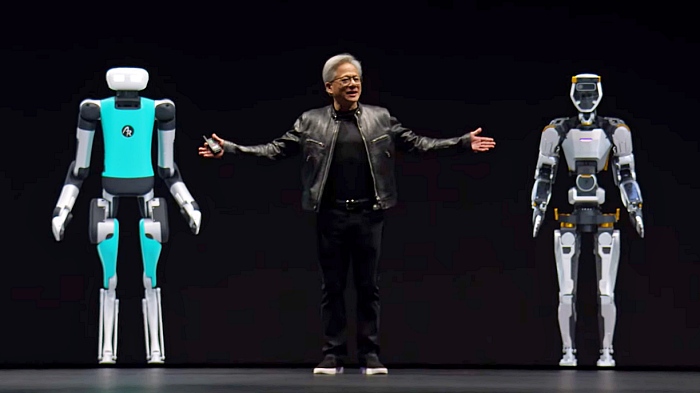
Nvidia has unveiled its H2+ humanoid robot reference design in partnership with Chinese humanoid robot company Unitree Robotics and Singapore-based robotic hand specialist Sharpa Robotics. It is presenting an integrated development platform spanning data collection, AI model training and real-world robot deployment, as it moves to expand its influence in the humanoid ecosystem beyond supplying semiconductors.
On June 1, the South China Morning Post reported that Nvidia unveiled the new humanoid reference system H2+ at Computex 2026 in Taipei, Taiwan.
The key to H2+ is that it ties the entire humanoid development process into a single standardised blueprint. In the robotics industry, a reference design serves as a standard platform that research institutes and companies can use as-is or modify as needed. The goal is to shorten development time and lower barriers to entry by integrating steps from data collection to AI policy training and deployment in real environments.
Nvidia CEO Jensen Huang (젠슨 황) stressed in a Computex keynote that the hardest problem in agent systems, robot systems and physical AI is data. He singled out a lack of data needed to train humanoids as a major challenge. Most video data on the internet is filmed from a third-person perspective, but robots need first-person data captured at human or robot eye level to work in real environments, he explained.
“To create data for AI robotics, you need the robot’s point of view,” Huang said. “Securing data is becoming a bigger bottleneck than model performance.”
The H2+ unveiled this time is based on Unitree’s human-sized humanoid robot H2. It combines Sharpa’s WAVE five-finger robotic hand, while Nvidia’s humanoid AI model platform Isaac GR00T provides the robot’s intelligence.
The computing platform is Nvidia’s latest AI processor, the Jetson AGX Thor T5000. Designed on the Blackwell architecture, the chip offers up to 128GB of memory and AI computing performance of 2,070 FP4 teraflops (TFLOPS).
Nvidia, through H2+, outlined a strategy to expand beyond being a simple chip supplier into a humanoid development platform provider. Huang said the goal is to help developers and researchers build and fine-tune advanced humanoids faster and deploy them in real-world sites.
Sharpa also described the collaboration as an important milestone toward commercialisation. David Lee Yifan (데이비드 리 이판), Sharpa’s founder, said the collaboration is meaningful progress toward deploying robots that perform real work in real environments. Founded in 2024, Sharpa is headquartered in Singapore and carries out research and development in Shanghai. The company is also participating with Nvidia in a data collection project for training robot foundation models.
Sharpa’s flagship WAVE robotic hand drew attention earlier this year at CES 2026 with demonstrations dealing blackjack cards and assembling a pinwheel. It features 22 active degrees of freedom (DoF), enabling detailed movements close to a human hand. Sharpa said it is also working to integrate the WAVE hand into the Unitree H2 platform.
Nvidia also unveiled new products on the day to strengthen its Physical AI strategy, along with H2+. Cosmos 3 is a world foundation model designed to understand the physical world from both first-person and third-person perspectives. It also laid out a plan to keep expanding the Isaac GR00T platform to build an open ecosystem that allows anyone to participate in humanoid AI research.
Nvidia dependence in China’s humanoid industry is also rising rapidly. Major Chinese robot companies including Unitree, AgiBot, Galbot and UBTech Robotics are known to be adopting the Jetson AGX Thor module for next-generation humanoid platforms.
The market is also growing fast. Morgan Stanley, in a recent report, projected annual humanoid sales in China to reach about 28,000 units this year. That is among the world’s largest. The report said the humanoid industry is likely to grow into a next-generation core industry that supports China’s manufacturing sector and export competitiveness.
In the industry, the H2+ unveiling is seen as a sign that competition to set a standard platform for humanoid development is accelerating beyond a simple reference design. In particular, as Nvidia builds a structure supplying semiconductors, AI models and development platforms, it is expected to further expand its influence in the humanoid industry ecosystem.
 Jinju Hong
hongjj@d-today.co.kr
Jinju Hong
hongjj@d-today.co.kr