
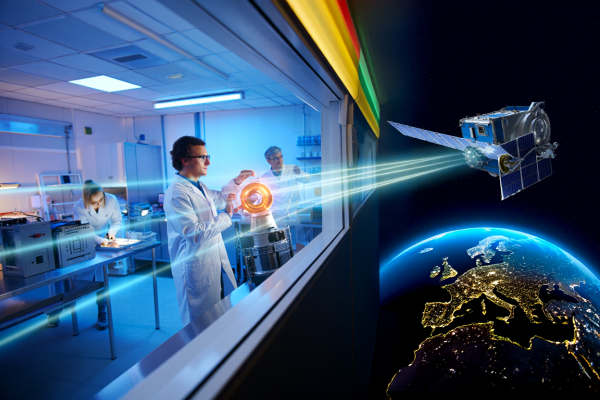
Lithuania is emerging as a new centre of Europe’s space industry, using expansion of the low-Earth orbit small satellite market as a springboard. As the space sector shifts from large satellites to constellations of small satellites that can be produced at low cost and in large volumes, Lithuania is being seen as raising its profile by pushing manufacturing capability and startup-friendly policies.
Tech outlet TechRadar reported on May 31 that the Lithuanian government has set a goal of expanding the space industry’s contribution to gross domestic product to about 1 percent by 2027. A representative company supporting that goal is local space startup NanoAvionics.
NanoAvionics has recently drawn attention after winning a contract to supply 280 satellites for satellite communications company Meridian Space’s project to build a low-Earth orbit satellite network. It is among the larger small satellite projects carried out in Europe’s space industry.
At the centre of the market shift is the spread of low-Earth orbit constellations. In the past, the space industry relied on a structure dependent on a few large satellites deployed in geostationary orbit. Recently, operating networks of hundreds to thousands of small satellites is spreading rapidly.
This model has the advantage of providing communications services over wider areas and shortening Earth-observation revisit cycles. Above all, it can significantly reduce development costs and build time, lowering entry barriers for private companies and emerging countries.
NanoAvionics is supplying modular platforms that can be applied from 10-kilogram-class CubeSats to 500-kilogram-class small satellites. The company said it has successfully launched more than 60 satellites so far and produces up to 80 percent of key satellite components in-house to secure quality control and supply-chain stability.
Andrew Swain (앤드루 스웨인), U.S. business development manager at NanoAvionics, said small satellites are changing the cost structure of the space industry itself. He said they reduce upfront investment costs and speed commercialisation for private companies, while giving governments a chance to build independent space infrastructure at relatively low cost.
The constellation model also has strengths in resilience. If the industry relies on a small number of large satellites as before, a single failure can affect the entire service. If many small satellites are distributed, some losses do not significantly affect operation of the overall system.
The Lithuanian government sees these industry changes as part of its national growth strategy. Edvinas Grikshtas (에드비나스 그릭슈타스), minister of economy and innovation, said the emergence of unicorn companies such as Nord Security and Vinted was not an accident. He said it was the result of sustained investment over the past 15 years in digital infrastructure and developing technical talent.
Lithuania said advanced technology fields have grown 170 percent over the past three years, including laser technology, information and communications technology, satellite manufacturing and related parts industries. NanoAvionics also plans to build a new production facility in the capital Vilnius on the back of the large contract and to hire about 100 additional engineering-focused specialists by 2030.
Lithuania currently has more than 40 space-related companies operating, and its startup ecosystem is expanding around the European Space Agency’s business incubation centre. It also holds associate membership status with the European Space Agency and is strengthening cooperation with France’s National Centre for Space Studies and the UK Space Agency.
The industry sees the future battleground in low-Earth orbit satellites as depending more on production efficiency and supply capability than on simple technical strength. The key factor determining market competitiveness is becoming how many satellites can be produced quickly and reliably.
Ultimately, Lithuania’s strategy is focused less on the satellites themselves than on building a manufacturing ecosystem capable of mass-producing them. As the low-Earth orbit satellite era takes hold, attention is on whether the small Baltic state can establish itself as a new hub of Europe’s space industry.
 Jinju Hong
hongjj@d-today.co.kr
Jinju Hong
hongjj@d-today.co.kr