
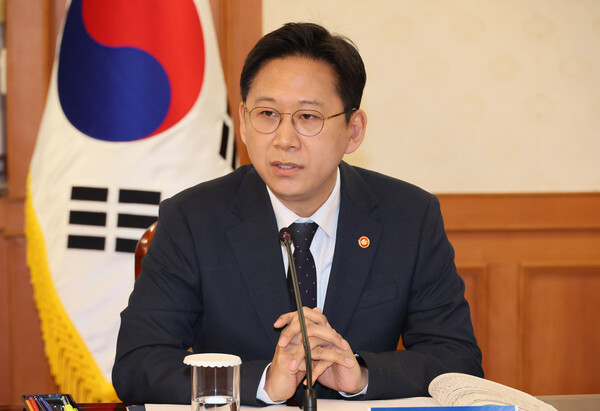
South Korea's National Artificial Intelligence (AI) Strategy Committee on Sunday disclosed major results it has pursued since its launch in September last year.
The committee became a statutory body in January after the AI Basic Act took effect. It currently operates 10 subcommittees, two special committees and one task force. It has held about 300 subcommittee meetings, four meetings of the Chief AI Officer (CAIO) consultative body and two plenary meetings.
Since its launch, it has produced major results including establishing a government-wide "Korea AI Action Plan", responding to national issues such as a fire at the National Information Resources Service, integrated disclosure of government AI budgets and full-scale AI cooperation between South Korea and the United Arab Emirates (UAE).
It first established the AI action plan. It prepared a draft through about 100 meetings over 100 days, an overnight debate session and discussions by the CAIO consultative body. It then confirmed the plan on Feb. 25 after collecting 559 public comments and coordinating among ministries.
The action plan is a government-wide implementation strategy with 99 implementation tasks and 326 policy recommendations, built around three policy pillars under a vision of "advancing to the top three in AI": building an AI innovation ecosystem, a nationwide AI-based major transformation and contributing to a global AI basic society.
For the issue of using copyrighted works for AI training, where industrial development and protection of creators' rights conflict, it agreed on four core tasks after an open meeting with associations and organisations on Jan. 15 and a minister-level meeting among the committee, the Ministry of Science and ICT and the Ministry of Culture, Sports and Tourism on Feb. 26.
It also announced two fundamental measures on Feb. 25 in response to a fire and security incidents that occurred last year at the Daejeon center of the National Information Resources Service. Through "AI Government Infrastructure Governance and Innovation Promotion Direction", it presented directions for redesigning the national information management system. It will first build 134 disaster recovery (DR) systems this year for the Daejeon center system and others, and pursue a private cloud-based DR pilot project for three core systems: dBrain, the Postal Information System and Safety Stepping Stone.
It also drew up a roadmap to introduce a coordinated vulnerability disclosure and vulnerability disclosure programme (CVD/VDP) and plans to shift to a preventive security system using white-hat hackers.
It also disclosed integrated information on government AI budgets. It disclosed a total of 9.9 trillion won across 741 projects in 41 ministries on March 4.
On April 24, it agreed with the Ministry of the Interior and Safety and the Ministry of Culture, Sports and Tourism to restrict attachments of hwp files in government systems such as Onmail. It is also pushing to expand open document formats such as hwpx and markdown.
It also operated working groups in five fields as follow-up measures after a state visit to the UAE last year. From the 12th to 13th of this month, relevant ministries jointly held the "Korea-UAE AI Infrastructure and Semiconductor Investment Forum", attended by about 30 government and business delegates including a vice minister of the UAE Ministry of Investment.
Bae Kyung-hoon (배경훈), vice prime minister for science and technology and vice chair of the committee, said the committee has laid a solid foundation for advancing to the top three in AI, from establishing the action plan and responding to national issues to improving policy transparency. He said it will continue to review and support AI policies and projects across ministries as a national AI control tower and further strengthen communication with the field.
 Seul-gi Son
sageson@d-today.co.kr
Seul-gi Son
sageson@d-today.co.kr