
South Korea's Ministry of Science and ICT said its key achievements in the first year after the launch of the Lee Jae-myung government include laying the groundwork for a push to become one of the world’s top three AI powers, restoring the research and development ecosystem and guaranteeing basic communications rights. The ministry said it will flesh out policy results in its second year by expanding services based on homegrown AI models, launching the K-Moonshot project and shifting to an AI security system. It will also speed up the rollout of “AI for Everyone” so all citizens can benefit.
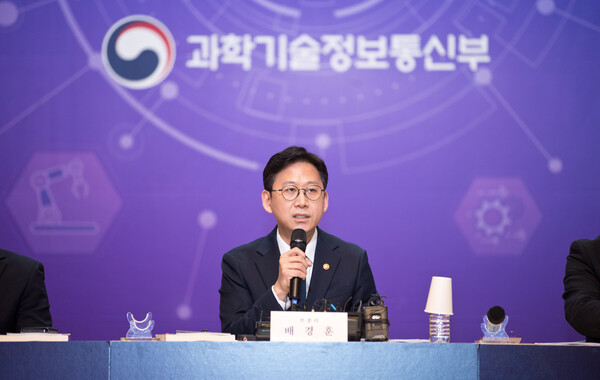
The ministry held a press briefing on May 29 at the Central Post Office in Jung-gu, Seoul, and announced its core policy achievements over the past year and its policy direction going forward.
With the launch of the People’s Sovereignty Government, the ministry was elevated to a deputy prime minister-level science and technology ministry for the first time in 17 years. Over the past year, it pursued state tasks focused on laying the groundwork to become a top three AI power, restoring and normalising a challenging R&D ecosystem, and guaranteeing basic communications rights and easing household burdens.
Laying the groundwork for a top three AI power... building a GPU-centred “AI expressway”
The ministry first cited securing global AI competitiveness as a major achievement. Based on the performance of homegrown AI models, South Korea ranked third in major global evaluations such as Stanford University’s AI Index and the Artificial Analysis Intelligence Index (AAII). It is also continuing cooperation with global big tech companies including OpenAI, Nvidia and Google DeepMind.
It also presented expanding national AI infrastructure as an achievement. The ministry said it is smoothly pushing a plan to secure 260,000 advanced graphics processing units by 2030. It also said it has put in place a legal foundation by enforcing the AI Basic Act, a general AI law enacted as the world’s second, in January, and enacting an AI Data Center Special Act in May that includes regulatory easing measures.
Deputy Prime Minister and Science and ICT Minister Bae Kyung-hoon (배경훈) cited building a GPU-centred “AI expressway” as the biggest achievement. “It seems we no longer hear voices saying it is hard to produce research results due to a lack of GPUs,” he said. “We are also pushing AI transformation (AX) at an all-government level. The government and private sector have formed a consensus, and a playing field for investment (related to AI) has been 마련됐다,” he added.
The expansion of AI use is also gaining traction. The ministry said homegrown AI models are being applied in industrial and public areas such as semiconductor factories, government administrative networks and reviews of R&D budgets. AI full-stack technology that combines AI models, AI semiconductors and services has laid the groundwork for entry into overseas markets such as Saudi Arabia. A domestic corporate consortium signed a memorandum of understanding with Saudi Aramco Digital in February.
It also pushed to strengthen AI capabilities for all citizens. The ministry expanded AI Digital Learning Centers to 69 locations from 37, and increased the number of people trained in AI use to 1.3 million from 910,000. It set a goal of more than 2 million participants by year-end for a nationwide AI competition it held for the first time this year.
The ministry will begin in earnest this year to kick-start the rollout of “AI for Everyone”. It aims to provide AI-specialised services in a chatbot format, including for older people and underprivileged groups. The service is expected to start as early as November and remain free through 2028.
Bae said “AI for Everyone” would become a concept in which all citizens own an AI agent. He said the government aims to continue providing “AI for Everyone” for free even after 2028 through government support and joint investment by companies.
It also plans to speed up efforts to secure artificial general intelligence (AGI) technology. Kim Kyung-man (김경만), head of the Artificial Intelligence Policy Office, said AGI also requires significant support for GPUs, data and talent at the level of frontier models. He said the ministry plans to step up work on AGI development by securing an additional budget.
Easing telecom fee burdens and normalising R&D also presented as key achievements In telecommunications, it cited guaranteeing basic communications rights and easing public burdens as key achievements. The ministry said it expanded a data-safety option, previously mainly applied to mid- and high-priced data plans, to all data plans. It said it revamped the system so users can continue to use basic services such as messengers and navigation even after exhausting their data allotments.
It also presented a plan to provide additional voice and text services for older people to build a communications environment that leaves no one behind in the AI era. For companies with repeated security incidents, it revised the Information and Communications Network Act in March to strengthen corporate accountability, enabling punitive fines of up to 3 percent of revenue.
In R&D, it highlighted budget expansion and institutional improvements. The government allocated an R&D budget of 35.5 trillion won, the largest ever. That was a 20 percent increase from the previous year. The ministry’s basic research budget also rose 17 percent from a year earlier to 2.74 trillion won, and the number of new projects increased to 7,022 from 3,772.
It also abolished the R&D preliminary feasibility system, a long-standing request from researchers, for the first time in 18 years. As a result, the time from submission of project plans to budget allocation and adjustment was shortened to 5 months from 2 years. It also pushed measures including abolishing the project-based system (PBS), creating new categories for autonomous use of research funds, switching indirect cost rules to a negative system and simplifying administrative forms.
Support for science and technology talent was also expanded. The number of recipients of the master’s excellence scholarship increased to 1,625 from 1,000. It created a doctoral excellence scholarship for the first time this year to support 1,000 people. In the first half of the year, it attracted about 200 outstanding overseas talents to South Korea.
The ministry also launched the K-Moonshot project to raise productivity in science and technology research based on AI and solve national missions. The Science and Technology Ministerial Meeting, launched in November last year, is being run as an all-government coordination and cooperation platform. It is tasked with integrating technology management systems across ministries and supporting AI transformation (AX) in the public sector.
In the second year, focus on tangible results... pushing shift to AI security system
In its second year, the ministry plans to focus on delivering tangible results by linking existing policies. It will apply the “AI for Everyone” project to public AI education and to public and private sector AX to boost public experience. It will also pursue securing large-scale references to expand the use of AI semiconductors. It said it aims to strengthen the K-AI ecosystem and enhance full-stack competitiveness combining AI models, semiconductors and services.
It will also strengthen the AI security response system. The ministry plans to form an emergency response team for the private sector to respond to high-performance and high-risk AI cyber threats, and to build unified vulnerability and patch management and an emergency response system. It plans to shift to an AI security system by securing security sovereignty based on homegrown AI technology and expanding zero trust.
In science and technology, it plans to push entry into the world’s top five science and technology powers by embedding a challenging, mission-oriented R&D ecosystem in the field. The ministry will announce the 6th Basic Plan for Science and Technology and the 2nd National R&D Mid- to Long-Term Investment Strategy, and present milestones for each K-Moonshot mission. It aims to generate major results in strategic fields including semiconductors, small modular reactors (SMRs), humanoids, quantum and bio.
Bae said the ministry is becoming one of expectation and hope. He said it tried to stay true to fundamentals rather than focus on visible work, and that it will continue to serve as an organisation that builds South Korea’s mid- to long-term future.
 Jin-ho Lee
jhlee26@d-today.co.kr
Jin-ho Lee
jhlee26@d-today.co.kr