
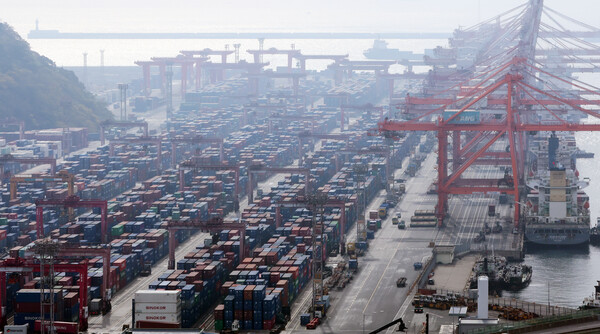
Semiconductors, defense, shipbuilding and power equipment are expected to lead South Korea's exports in the second half. Geopolitical tensions originating in the Middle East are dragging on and have sent Strait of Hormuz shipping rates sharply higher, but simultaneous strength in the four industries is seen absorbing external shocks.
That trend also underpinned the Bank of Korea's recent decision to raise its economic growth forecast for this year by 0.6 percentage points. In revised projections released on May 28, it lifted its forecast for this year's real gross domestic product (GDP) growth to 2.6 percent from 2.0 percent. That is well above potential growth of about 1.8 percent and the highest in 4 years since 2022, when growth was 2.7 percent. The revision reflected first-quarter GDP growth of 1.7 percent from the previous quarter, nearly twice the earlier forecast of 0.9 percent. The central bank also raised its forecast for next year's growth by 0.3 percentage points to 2.1 percent from 1.8 percent, judging the semiconductor cycle will extend into next year. It also raised its forecast for this year's consumer inflation to 2.7 percent from 2.2 percent to reflect the burden of high oil prices.
The key driver of the export upturn remains semiconductors. Demand for high-bandwidth memory (HBM) and commodity DRAM is rising rapidly as AI services spread and data centre investment surges. Supply is not keeping up with demand growth because memory companies are taking a cautious approach to capacity expansion and there are technical difficulties in producing high-performance products. Hana Securities assessed that favourable semiconductor conditions are likely to last at least through year-end. As a result, the current account surplus is expected to put upward pressure on the won, with the dollar-won exchange rate forecast to fall gradually to 1,420 won in the fourth quarter from 1,470 won in the second quarter.
Another driver supporting the second half alongside semiconductors is defense. DS Investment & Securities analysed that a global increase in defence spending and expanded weapons purchases are continuing regardless of whether the wars in Russia-Ukraine and the Middle East end, and that a full-fledged rise in earnings and share prices is expected from the second half. Cheongung-II, which recorded an interception success rate of about 96 percent in combat in the UAE in March, increased the possibility of additional orders from Saudi Arabia, Kuwait and Qatar, among others. Entry into the western and southern European markets, which South Korea's defence industry has not been able to access, has also become visible. Hanwha Aerospace signed an agreement in March with Spain's Indra to develop and produce a K9-based self-propelled howitzer, and France is reviewing Chunmoo to replace 9 ageing LRU units.
Kim Jeong-gwan (김정관), the industry minister, said exports could top $900 billion this year.
The government also expressed confidence. Kim, the minister of trade, industry and energy, raised on May 27 the possibility that exports this year could exceed $900 billion at a press briefing. That would match the Korea Institute for Industrial Economics & Trade's projection of $924.4 billion in exports on a customs clearance basis, up 30.3 percent from a year earlier. Kim said people say semiconductors are driving exports, but other sectors also rose 13 to 15 percent and exports by small and medium-sized enterprises increased 10 percent, stressing that the base of the upturn is broadening.
Shipbuilding is also strengthening South Korea's competitiveness as the global supply landscape reshapes. According to Shinhan Investment Corp, Japan's share of global compensated gross tonnage (CGT) fell sharply to below 5 percent in January to May this year from 29 percent in 2015. China, despite a share in the 70 percent range, is seeing structurally reduced access to Western clients due to U.S. Trade Representative (USTR) sanctions on China's shipbuilding and shipping. South Korean docks are effectively filled through 2027 to 2028. Orders for LNG carriers reached 37 ships in January to April, already exceeding last year's full-year orders of 38 ships.
A consortium of Hanwha Ocean and HD Hyundai Heavy Industries is on the shortlist, along with Germany, for Canada's next-generation submarine procurement project worth 60 trillion won, with a final announcement due next month. Kim mentioned he met Canada's Industry Minister Melanie Joly right after the proposal deadline and said the meeting itself was a message. South Korea's proposal is also assessed to have an advantage in terms of price and specifications.
The power equipment industry is also showing clear growth momentum. AI data centres, grid ageing and accelerating electrification are acting at the same time, pushing the U.S. transformer market into a supercycle. Shinhan Investment Corp forecast the global transformer market will grow 10 percent annually, to $137.7 billion in 2030 from $61.3 billion in 2024.
Combined order backlogs at South Korea's top three firms stood at 33 trillion won in the third quarter, up 23 percent from a year earlier, securing visibility of 5 to 6 years. Hyosung Heavy Industries holds about 50 percent of the U.S. 765 kilovolt market and won a single order worth 787.0 billion won from the biggest U.S. power transmission network operator in February. An analysis said asymmetrical barriers to entry have formed because only 10 companies globally can manufacture 765 kilovolt transformers and lead times reach 130 weeks.
The variable is oil prices. Hana Securities expects oil to stabilise back to pre-war levels in the fourth quarter. It said guarantees of safety in the Strait of Hormuz, a resumption of production by Middle Eastern oil-producing countries and the pace of output increases by non-OPEC countries are expected to determine the timing of recovery. The Bank of Korea's decision to raise this year's inflation forecast to 2.7 percent also reflected the burden of high oil prices. Still, an assessment said that as the four industries have entered a phase of structural growth at the same time, new growth engines are absorbing external shocks and underpinning export momentum in the second half.
 Dae-geon Seok
d2dg@d-today.co.kr
Dae-geon Seok
d2dg@d-today.co.kr