
[DigitalToday reporter Chi-gyu Hwang] "Even if there is no problem using automation tools at the team level, the moment you scale them across the company, things become complicated. Implementing IT operations automation company-wide is harder than you think. Automation environments are fragmented across the organisation, and responsibility differs from one group to another. This should be approached from a governance perspective, not technology, and accountability must be made clear."
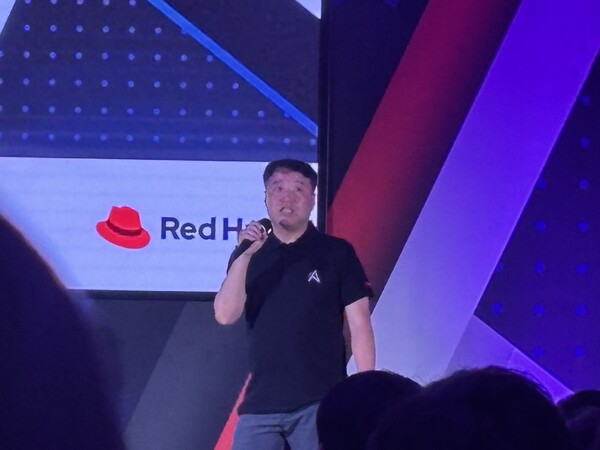
Hwang In-soo (황인수), an executive director at Red Hat Korea, highlighted that to solve problems that arise when expanding automation enterprise-wide, organisations must first define governance and operating models rather than focus on technology.
At Red Hat Ansible Automate 2026, held on the afternoon of May 28 at Lotte World Tower in Jamsil, Hwang said script-based automation projects at the team level can be carried out quickly, but once expanded to an enterprise organisation, mismatches between security and operations are certain to emerge. He repeatedly stressed the need for comprehensive thinking about the operating model.
Hwang pointed to "distributed environments" as a reason it is difficult to expand automation in enterprise settings.
He said distribution is not merely a technical issue. Organisations, platforms, goals and inter-organisational responsibilities are dispersed in different ways, which leads to fragmented automation. As a result, it is difficult to solve fragmentation across organisations with technology alone.
Hwang said data centres, security, networks and IT automation operations organisations each have different requirements, while automation targets are also complex, spanning physical servers, virtualisation, cloud, edge and AI environments. He said enterprise-grade automation is not simply a technology and scripting issue, and is possible only when organisational governance, meaning a corporate operating model, is defined first.
He said organisations should set policies in advance on how to integrate requirements across groups, how far to define the scope of automation, who will take operational responsibility and how the platform will be used after adoption.
Red Hat Ansible is an open-source IT automation engine that automates complex IT infrastructure and application deployment as code. Red Hat is accelerating its push into the enterprise automation market with Ansible Automation Platform (Ansible Automation Platform, APP), which optimises the open-source Ansible project for corporate environments. It is focusing on solving problems that arise in implementing enterprise automation. Hwang described APP as an operating system that connects the entire automation lifecycle through a single platform, rather than a simple execution tool. He said it integrates and provides content creation, execution and policy management, support for distributed execution structures, event-driven response and AI-based productivity support functions.
He also said that when automation is operated differently by each organisation, development and operations risks emerge, operating standards do not align and accountability becomes unclear. He stressed that APP converts automation assets into reusable integrated operations platform capabilities, turning automation from short-term projects into long-term corporate operating assets.
Hwang also stressed the need to change how automation performance is measured. He said automation teams view the number of playbook runs as a performance metric, while management looks first at service stability, operating speed, fewer failures, shorter deployment times and operating costs. He said automation KPIs lie not in the number of executions but in how quickly and safely the business can operate, and that automation organisations must become an engine that delivers the business outcomes management wants, namely the realisation of corporate value.
On costs, he also said it is not realistic to compare open-source-based automation tools and enterprise platforms solely on licensing costs.
He said what should be weighed more in actual operations are hidden risk costs stemming from access management errors, the absence of governance and operating standards, and the lack of audit tools. He said automation costs should be redefined by considering total cost of ownership together with the potential to reduce risks. He also stressed that automation effects should be defined as time reallocation rather than headcount reduction, adding that as repetitive work declines, IT engineers can focus on higher-value strategic work and failure-prevention activities.
 Chi-gyu Hwang
delight@d-today.co.kr
Chi-gyu Hwang
delight@d-today.co.kr