
[DigitalToday reporter Chi-gyu Hwang] "We are introducing automation to improve IT operations efficiency, but we are getting a lot of feedback that operations are becoming more complex. We need an optimisation strategy that can use automation properly in a multimode environment depending on the situation."
Lee Min-sung (이민성), a managing director at Red Hat Korea, stressed that enterprise companies face limits if they only add tools to deliver meaningful results from IT operations automation. He underscored the importance of optimising automation strategies to fit different workloads.
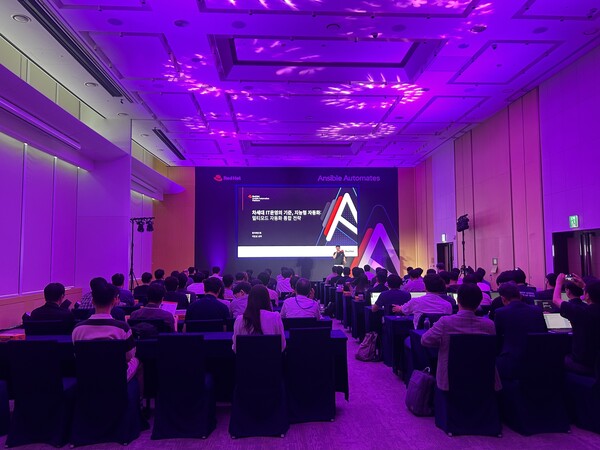
Speaking on the afternoon of May 28 at the Red Hat Ansible Automate 2026 event hosted by Red Hat Korea at Lotte World Tower in Jamsil, Lee said global IT leaders still cite improving the level of IT infrastructure operations automation as a top concern among infrastructure modernisation tasks. He introduced challenges companies need to solve to modernise automation and Red Hat's strategy.
Red Hat Ansible is an open-source IT automation engine that automates complex IT infrastructure and application deployment as code. Red Hat is accelerating its push into the enterprise automation market with Ansible Automation Platform (APP), which optimises the open-source Ansible project for enterprise environments. It is focused on solving problems that arise in implementing enterprise automation.
According to Lee, use of automation tools is increasing at companies, but fragmentation often prevents efficient use. Integration is also not as easy as expected. He said there are not many cases where it leads to actual integration because technologies, organisations and operating methods differ within companies. He said companies adopt automation tools to solve problems but end up with one more tool to manage.
Lee said having many tools is not necessarily better and that it is important to select and use solutions suited to the environment. He presented "multimode automation" as the answer.
Multimode automation centres on mixing three approaches depending on the situation: task-based, event-driven and agentic AI-driven automation.
Task-based automation is the most common approach and accounts for about 80 percent of overall automation work. It automates predictable repetitive work such as rolling out security patches in bulk, creating user accounts and deploying standard configurations.
Lee cited an example using infrastructure management solution Red Hat Satellite and IT automation tool Ansible. "If Satellite automatically detects a security vulnerability, Ansible automatically runs the patching job. Without human intervention, patches can be applied consistently and quickly to thousands of servers," he said.
Event-driven automation responds immediately in line with predefined operating policies the moment a specific event occurs.
Lee cited cases where an outage continues until the next morning if a person in charge cannot respond immediately when an operating system falls into a hang state, where it stops responding to user commands such as mouse clicks or keyboard input. "If a monitoring system detects an OS hang event and is set so that Ansible automatically reboots it, an immediate response is possible without human intervention," he said. He added that for known, repetitive types of failures, event-driven automation alone can deliver operational effects comparable to AIOps without AI.
The last approach is agentic AI-driven automation, where AI not only analyses and judges but also executes.
Lee said AI is specialised in analysing and judging problems but still has limits in actually connecting to systems and carrying out tasks. "We need a structure where event-driven automation carries out actual execution based on what AI has judged. Only when AI and event-driven automation are combined can we properly feel the effects of agentic AI automation," he said.
Securing governance is also an important element in AI-driven automation. Lee said that rather than granting authority directly to an AI system, a structure is needed that places an automation layer in between to define and monitor functions AI can perform. "It is important to secure accountability and an audit system at the automation layer," he said.
In the presentation, Lee repeatedly stressed that for automation to take root in enterprise environments, a structure that can use task-based, event-driven and agentic AI-driven automation in the right places is key. "What matters is not operating the three automation modes separately, but how organically you connect and operate them depending on the situation. This changes IT operations competitiveness," he said. "Red Hat APP supports three automation modes, task-based, event-driven and AI-driven, on a single platform," he said.
 Chi-gyu Hwang
delight@d-today.co.kr
Chi-gyu Hwang
delight@d-today.co.kr