
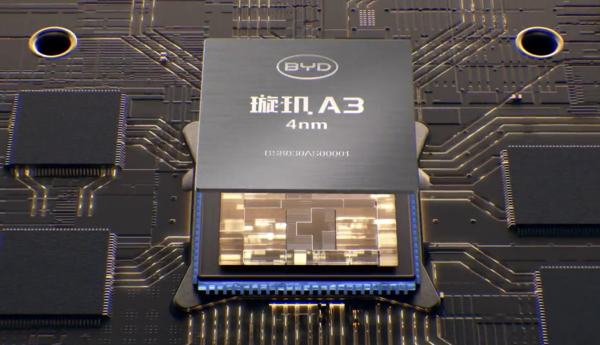
[DigitalToday reporter Jinju Hong (홍진주)] Chinese electric vehicle maker BYD has unveiled China’s first self-developed 4-nanometre smart driving chip and started full-scale mass production. After batteries and charging technology, it is also moving to develop automotive semiconductors in-house, reinforcing its strategy of building a vertically integrated supply chain.
Electrek, an electric vehicle outlet, reported on May 28 local time that BYD unveiled its driver-assistance chip, the Xuanji A3, at a recent intelligent strategy launch event.
The chip is a 4nm-process driver-assistance semiconductor designed by BYD. BYD Chief Executive Wang Chuanfu said the Xuanji A3 supports Level 3 and Level 4 autonomous driving and stressed that it is among the top-tier intelligent driving chips in China.
BYD also promoted an integration strategy spanning vehicle architecture and software, alongside chip performance. The company said it combined its in-house God’s Eye advanced driver-assistance system (ADAS) with the Xuanji architecture and algorithms to raise computing efficiency by 100%. It also said total computing performance exceeds 2,100 TOPS when running three chips simultaneously.
What stands out is that BYD developed the chip in-house rather than relying on external semiconductor companies. While most automakers depend on outside suppliers such as Nvidia, Qualcomm and Mobileye, BYD has built a structure in which it sources many key vehicle components internally.
Wang said BYD is the world’s only automaker that fully controls the driver-assistance supply chain. He said the vertical integration strategy helps cut costs, advance technology and speed up new vehicle development.
BYD’s semiconductor localisation strategy has been in place for a long time. The company has developed more than 2,000 chips since setting up a dedicated computer chip unit in 2002. It currently operates 5 semiconductor wafer plants, and its investment in semiconductors is known to have exceeded 100 billion yuan. Related research and development headcount also totals more than 7,000 people.
Recently, BYD has rapidly expanded the scope of in-house development of key vehicle technologies. At a technology event in March, it also unveiled the Blade Battery 2.0 and a flash-charging system. At the time, the company presented more than 1,000 km of driving range under China’s CLTC standard and fast-charging performance requiring as little as 5 minutes.
The industry views the Xuanji A3 unveiling as more than a simple vehicle chip announcement, and as an example showing BYD is transforming into a comprehensive technology company spanning batteries, charging and autonomous-driving semiconductors.
With most global automakers still relying on external companies for key semiconductor supply chains, BYD is seeking differentiation by building a supply system in which it sources nearly all areas in-house. Attention is focused on whether it can strengthen an edge in the electric vehicle market in terms of technology deployment speed and cost competitiveness.
 Jinju Hong
hongjj@d-today.co.kr
Jinju Hong
hongjj@d-today.co.kr