
Nvidia's next-generation AI-focused CPU, Vera, posted performance close to AMD's high-end EPYC lineup in public benchmarks and led in some sections.
On May 29, online outlet Gigazine reported that Vera ranked among the fastest in single-socket tests and delivered performance similar to a dual-socket AMD flagship CPU in some code compilation tasks.
The performance assessment was based on public benchmarks conducted by Linux-focused outlet Phoronix at the invitation of Nvidia's headquarters. Vera is a data centre AI and high-performance computing CPU targeted for deployment in the second half of 2026. Unlike the previous-generation Grace, which used Arm Neoverse V2 cores, Vera features Nvidia's in-house Olympus cores.
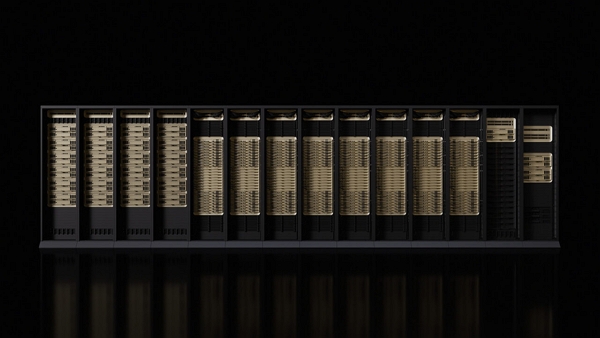
The chip configuration also changed significantly. Vera has an 88-core, 176-thread design and supports FP8 operations. Paired with LPDDR5X memory, it provides up to 1.2TB per second of memory bandwidth. L2 cache is 2MB per core and unified L3 cache totals 164MB. It also supports PCIe 6 and CXL 3.1. The rack-scale product, Vera Rubin NVL72, is made up of 72 Rubin GPUs and 36 Vera CPUs, and the CPU will also be supplied as a standalone product.
The tests were run on a Vera system with the full 88-core configuration, using eight 96GB LPDDR5-9600 memory modules. Peak TDP was listed at 450 watts, and actual power consumption was mentioned as under 30 watts.
The strongest performance was in code compilation tasks. Vera delivered results similar to a dual-socket 5.0GHz AMD EPYC 9575F and was the fastest among the tested chips on a single-socket basis. In Node.js compilation, it completed the task in less than half the time of Grace, and per-core performance was assessed as similar to AMD's high-clock EPYC lineup.
In a Linux kernel build test, Vera posted the fastest result at about 20 seconds. In the allmodconfig x86_64 kernel build, it trailed slightly behind dual-socket EPYC 9575F and 9755 configurations with more cores, but it was the top performer among single-socket systems.
Nvidia highlighted the results, saying Vera showed generation-to-generation performance gains across a range of CPU-intensive tasks including code compilation, file compression, video transcoding, Python and Java execution, and database processing. The company said these workloads would become core computing areas in future AI agent and AI factory environments.
The benchmark is being read as an example of Nvidia showing CPU design capabilities beyond GPU-centred AI infrastructure. It is being assessed as meaningful because it is the first time detailed results have shown how far real-world compilation and system-task performance has improved after shifting to in-house core designs for the next server CPU following Grace. If Vera is deployed in earnest in the second half of 2026, Nvidia's CPU competition against AMD EPYC and Intel Xeon in the AI server market is expected to intensify.
 Jinju Hong (홍진주)
hongjj@d-today.co.kr
Jinju Hong (홍진주)
hongjj@d-today.co.kr