
Naver is pursuing both a stronger artificial intelligence (AI) creator ecosystem and more advanced AI search. It reflects its view that competition in the AI era is shifting beyond model performance to data and content quality and service experience.
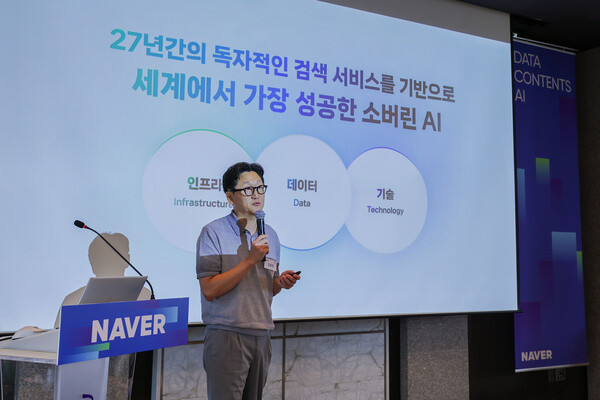
Naver on May 28 held a media round table at The Plaza Hotel in Seoul’s Jung-gu district under the theme “Naver’s data and content strategy in the AI era”. Attendees included Chief Data and Content Officer (CDO) Kwang-hyun Kim (김광현), Content Service Division head Il-gu Lee (이일구) and Search Platform Division head Sang-beom Kim (김상범). It was the first time Kim has appeared publicly since being appointed CDO from head of search in February.
Kim assessed that performance gaps among AI models are narrowing. He said each new model touts “top performance,” but the lead is reversed again after a few months. “In this situation, what data you have is becoming more important than simple model technology,” he said. He also cited Google’s annual content licensing deal with Reddit worth about $60 million as an example showing competition to secure data in the AI era.
Naver presented its content ecosystem as its strongest asset. About 20 million creators are currently active on Naver, producing more than 630 million pieces of content annually. Since January, user-generated content (UGC) such as blogs and cafes has accounted for 70 percent of content cited in AI Briefing. Il-gu Lee said, “Experiences and reviews written directly by Korean users are creating differences in AI service quality.”
◆Citation-based creator support for AI...strengthening the UGC ecosystem with 'Naver Mate'
Naver will launch a creator support program called Naver Mate from June to strengthen this structure. It will provide support payments based on how much AI Briefing cites a creator’s posts.
Under the selection method, Naver will pick about 3,000 creators each month with high AI Briefing citation counts across 10 categories such as travel, lifestyle and tech and 25 topics such as health, childcare, movies and automobiles. Selected creators will have a Naver Mate emblem displayed on their profiles and content, and an environment will be provided to help their content be discovered more easily in integrated search and AI Briefing. They will also be able to check in their profiles how many times their posts were cited in AI Briefing.
The program’s annual funding will be about 20 billion won. Naver will pay a base 300,000 won per month to the selected 3,000 people. It will also add 3 million won per month to a total of 100 people, 10 in each of the 10 fields, and 10 million won per month to a total of 10 people, one top-ranked person in each field. During the beta period, it will pay in cash. It will start in June for creators on blogs, cafes, Knowledge iN and Premium Content, and plans to expand to clip creators in the second half of the year.
With concerns being raised that traffic to original posts may fall as AI answers expand, Naver Mate is also interpreted as a countermeasure linking AI citation indicators with creator support. Naver chose to make creators more visible on the AI answer screen and to directly compensate individual contributions through citation indicators and support payments. Lee said, “Rather than a content trading method between companies, I think it may be the world’s first in that it directly turns each individual creator’s contribution into an indicator.”
A remaining task is whether citation counts alone can sufficiently reflect content quality. Naver plans to refine the criteria while reviewing data during the beta operation period.
Beyond UGC, Naver is also expanding professional content partnerships. It is jointly producing education videos with EBS and collaborating on legal content with Beopmunsa and Parkyoungsa, and has secured data from about 1,400 specialist magazines. It is also working with global telecommunications company Reuters on English-language financial and economic content.
◆AI tab to fully open in late June..."From search to reservations, it ends inside Naver"
Its AI search service will also expand in stages. AI Briefing, launched last year, has become a core Naver search experience used by 30 million people a month. Naver plans to expand AI Briefing coverage to 40 percent within this year. The AI tab, released in beta to membership users in April, surpassed 3 million cumulative users in a month. It recorded a 36 percent reuse rate within a week and a 71 percent positive feedback rate.
The AI tab will open to all users in late June. Once an AI tab button appears in the mobile search bar, anyone will be able to use conversational search. The goal of the AI tab is to go beyond simple answers and link to execution. For example, if a user asks for a brunch restaurant near Seokchon Lake that can take a reservation for 3 people for Saturday lunch, the user can check business hours, available reservation times and location on a map on one screen and complete the booking. In late June, a new version of Smart Lens will also be released that links product photos taken with a camera to information checks and purchases.
The company also unveiled the technology strategy behind it. Sang-beom Kim presented three core assets: “product-native LLM,” “data and tools,” and “harness engineering.”
A product-native LLM, unlike a general-purpose AI model, is a dedicated model designed for Naver services and uses as training data the full user journey from searching and reading posts to purchases and reservations. Harness engineering is the operational capability to select and use the most suitable model depending on the query type.
Kim said, “An experience that runs end-to-end within one service, from search to product purchases and place reservations, is hard to find globally outside Naver.” He added, “Naver has strength in the product-native LLM that learns this whole process and the harness engineering that manages the entire journey.”
About 10 types of product-native LLM are currently applied to AI Briefing, the AI tab and the shopping AI agent. In June, the next-generation HyperCLOVA X model is set to be applied sequentially to some services starting with the AI tab.
Naver’s move to put a data and content strategy at the forefront under a CDO structure reflects its view that AI search competition is shifting from technology alone to competition over data acquisition and service execution capability. The more AI directly generates answers, the more platforms must continuously secure reliable content, and creators must be able to see how their content is used within AI services. Naver plans to use Naver Mate and an expanded AI tab to create a virtuous-cycle model that links creator compensation, content accumulation and improved AI service quality.
 Ho-jeong Lee
lhj@d-today.co.kr
Ho-jeong Lee
lhj@d-today.co.kr