
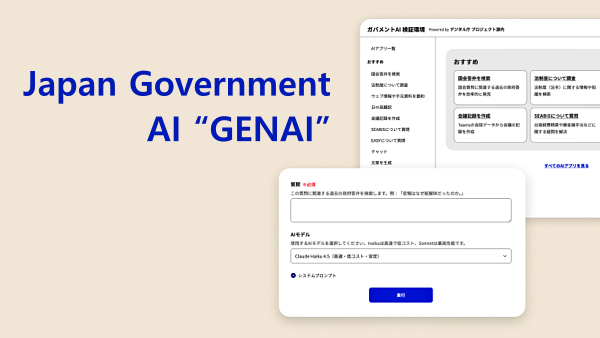
The Japanese government has officially disclosed that it is using generative artificial intelligence (AI) in the process of preparing answers for the Diet.
On May 27 local time, Japanese media outlet ITmedia reported that Digital Minister Hisashi Matsumoto (마쓰모토 히사시) told a House of Councillors plenary session, "This answer was also drafted by Gennai."
The remark came during questioning about how Japan is using Gennai, an in-house generative AI system developed for administrative work. Mizuho Umemura (우메무라 미즈호), a lawmaker from Sanseito, asked how much generative AI is contributing to streamlining bureaucratic work and to what extent it was used in drafting the Diet response that day. She said that even with AI, answers should not drift into overly hackneyed and formulaic language.
Matsumoto said it was difficult to explain in numerical terms the share of AI used across the entire process of preparing plenary-session answers. He said that for his own response, staff prepare a draft using Gennai, staff then conduct fact-checking, and he gives the final review and approval before delivering the answer.
Gennai is a generative AI system developed by the Japan Digital Agency. Unlike publicly available AI services, it operates within a closed, government-only network and was designed to reduce the risk of leaks of administrative documents and classified information. Japan began a pilot programme across all ministries in May, with about 180,000 participants out of roughly 290,000 general-service national civil servants.
Its use includes researching laws and systems and supporting the drafting of Diet answers. Japan aims to streamline administrative work through it. It is focusing in particular on cutting the time needed to draft initial texts for tasks such as Diet responses, where fact-checking and wording revisions are repeated.
On concerns that AI use could shift answers toward uniform expressions, Matsumoto argued it could instead improve work quality. "If we actively use AI, we can reduce the overall time for preparing answers, and staff can spend more time reviewing the content and carrying out detailed checks," he said. "As a result, it will become possible to write answers that are not formalistic and are more courteous and constructive," he added.
Japan plans to use the pilot programme to assess how far generative AI can be applied in administrative settings. There is also discussion of the possibility that Gennai's use could expand in areas such as legal reviews, drafting policy documents and Diet response work. Some have pointed to remaining key tasks, including how to manage the accuracy of AI-generated results, responsibility and concerns about administrative documents becoming uniform.
 Jinju Hong
hongjj@d-today.co.kr
Jinju Hong
hongjj@d-today.co.kr