
As electrification, software-defined vehicles (SDV), autonomous driving and generative AI technologies spread, winds of change are also blowing through car development methods. Interest is also growing in integrated platforms that connect companywide development processes into a single flow.
According to the related industry, vehicle development is no longer something that can be covered within a research centre in a specific region or within a single department. As a result, more companies are adopting platforms that allow global engineering organisations, external partners, manufacturing sites and supply chains to stay connected while maintaining the same data and a consistent decision-making system.
China's electric vehicle company NIO, founded in 2014, is one of them. NIO is an electric vehicle startup that set out from the start with the goal of expanding into global markets.
According to virtual twin software company Dassault Systemes, NIO initially had engineering teams dispersed across China, the United States and Europe that relied on different tools and written procedures, creating difficulties in collaboration and data sharing. Before the platform switch, it was not easy even for the North American team to check the Chinese team's progress in real time.
NIO chose a platform switch as a solution. It completed the switch in 4 months based on Dassault Systemes' 3DEXPERIENCE platform and its Electromobility Accelerator industry solution, and implemented an environment where it can access all vehicle data in real time regardless of location through ENOVIA, a product lifecycle management (PLM) solution.
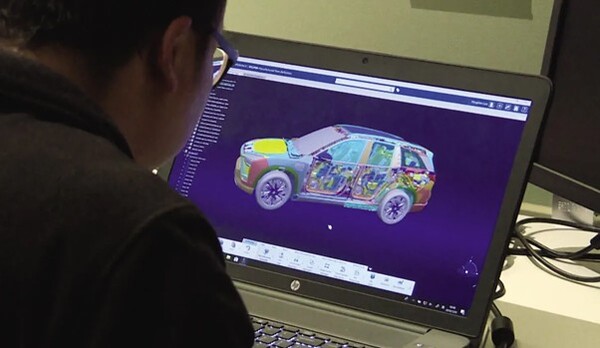
Engineers can review a vehicle 3D mock-up at any time in a virtual twin environment and perform slicing, measurement and digital mock-up inspection. The loading time for full vehicle data was cut to 15 minutes from more than 3 hours. It also built an environment where it can visualise and synchronise global production performance and quality in real time with plant partners by digitally planning and validating manufacturing processes through DELMIA, a digital manufacturing software.
The integrated platform led to faster development at NIO. NIO completed the process from concept planning to market launch for its flagship electric seven-seat SUV, the ES8, in 3 years. Compared with traditional automakers, which take at least 4 to 5 years to develop a new vehicle, it is assessed as a very fast pace.
Jaguar Land Rover (JLR), which owns the Jaguar and Land Rover brands, inherited various automotive industry software used by previous owners as it went through Ford and then was acquired by Tata Motors. It faced a fragmented IT environment as a result. Design data was scattered across multiple systems, and bottlenecks also occurred in data sharing and collaboration between teams.
As a solution, JLR pursued a business transformation programme called i-PLM with Dassault Systemes. With the goal of integrating companywide design data and building a virtual twin-based collaborative environment, it focused not on a simple system replacement but on redesigning work methods so product development organisations can collaborate based on the same data.
After the i-PLM transition, JLR achieved an effect of saving up to 40 percent of time in some product development roles. The company explained that clearing out the legacy IT environment and operating design, validation and collaboration on an integrated digital platform had a direct impact on development productivity.
Dongfeng Automobile Corporation (DFAC) improved its development process with a digital R&D platform.
DFAC conducted a parallel experiment by developing a new van on the 3DEXPERIENCE platform while developing a new truck using the existing method at the same time. The experiment was part of a plan to introduce a new R&D platform 추진 to advance DFAC's R&D capabilities.
DFAC used CATIA and the Global Modular Architecture Solution on the 3DEXPERIENCE platform to develop the van on a virtual twin basis. As a result, design process efficiency improved by 30 percent compared with the existing method, and design problems fell by 70 percent.
The company explained that the result came from managing the entire product development lifecycle in a single integrated environment, which reduced data disconnections between departments and repeated errors.
The related industry expects vehicle development complexity to increase as electrification and the shift to SDVs accelerate. It says digital transformation is needed that goes beyond digitalising tools and is closer to rebuilding development methods.
Dassault Systemes emphasised that "in this situation, batteries, software, electrical and electronic systems, thermal management, manufacturing processes and the supply chain must be considered at the same time, and the impact of a single design change on the entire system must be quickly verified. If data is disconnected by department or regional organisations depend on different systems in this process, both development speed and quality will inevitably be limited. If companies can use a virtual twin and a real-time collaborative environment based on an integrated platform, they can respond more quickly to market changes while controlling complexity," it said.
 Chi-gyu Hwang
delight@d-today.co.kr
Chi-gyu Hwang
delight@d-today.co.kr