
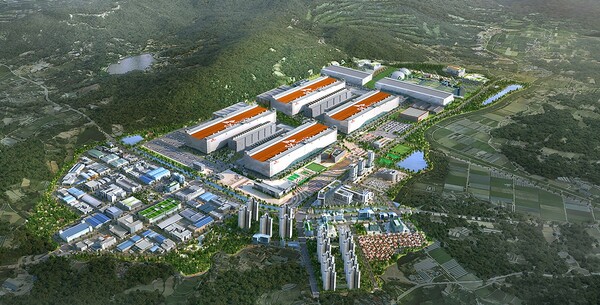
The Yongin semiconductor cluster’s ability to supply power on its own stands at just 1.9 gigawatts, equivalent to a quarter of power demand in the Seoul metropolitan area, it showed. That leaves it needing to draw more than eight times that amount from outside sources compared with the 15 to 16 GW required for full operation. A warned saturation threshold for transmission lines in the capital region is emerging as a factor that could shake the pace of investment execution in South Korea’s advanced industries.
A National Assembly Research Service report titled "Controversies and realities surrounding the creation of the Yongin semiconductor cluster" said about 15 to 16 GW of electricity is needed for the cluster to operate fully. That amounts to about 25 percent of total power demand in the Seoul metropolitan area. By contrast, power supply capacity in the Yongin area currently remains at about 1.9 GW.
Korea Electric Power is 추진ing a 37.0 billion won, 1,153-km 345-kilovolt transmission network project to bring generating capacity from the east coast and the Honam region. Considering the urgency of the matter, it even received an exemption from a preliminary feasibility study from the Ministry of Economy and Finance. But whether the long-distance transmission network, targeted for 2036, can be completed on time remains uncertain. KEPCO is also pursuing a plan to build a 3-GW LNG power plant itself at the initial stage to secure temporary power.
Uncertainty over power infrastructure has already spilled into political debate. In early 2026, calls emerged to relocate the Yongin semiconductor cluster to the provinces, citing transmission line saturation and limits in securing power. The North Jeolla branch of the Democratic Party set up a "special committee to relocate Samsung Electronics’ Yongin semiconductors to North Jeolla". The National Assembly Research Service analysed that, given the characteristics of the semiconductor industry, if power supply instability such as a blackout occurs, an entire production line can stop, making it difficult to guarantee the stability of private investment worth hundreds of trillions of won through only a simple quantitative infrastructure supply plan.
The problem is that demand for new AI data centres is concentrated in the same area, adding to the burden. Hanwha Investment & Securities said global data centre power consumption could rise from about the 400 terawatt-hour range in 2024 to above 500 TWh in 2026. Under a high-growth scenario, it is expected to approach 1,000 TWh in 2030. Domestic data centre power demand is also estimated to rise by more than 11 percent a year on average.
AI-focused data centres operate 24 hours a day under high load, and there are even cases where a single site forms a load equivalent to that of one large city. The structure directly affects power planning in a specific region and the schedule for expanding transmission networks. In the United States, data centre power demand is expected to rise from 42 GW in 2025 to 80 GW in 2035, and AI-centred data centres are expected to expand by more than four times. Global data centre capital expenditure was tallied at more than $220 billion in 2025.
National Assembly Research Service: "Cannot guarantee stability of private investment worth hundreds of trillions of won"
In regions where demand is concentrated, transmission networks act as bottlenecks. Hanwha Investment & Securities analysed that output curtailment restricting renewable energy generation and widening price gaps between regions are becoming frequent in parts of Europe, the United States, Eastern Europe and Southern Europe. It said more cases are emerging in which actual renewable energy utilisation and project profitability are lower than expected due to insufficient transmission networks and grid flexibility. In the U.S. PJM power grid, transmission and distribution costs are driving overall power price increases, and capacity auction costs borne by households and companies over a year surged to $16.1 billion, marking a record high.
This structural change is directly linked to the location competitiveness of South Korea’s advanced industries. Hanwha Investment & Securities assessed semiconductor fabs and AI data centres as industries that are extremely sensitive to blackouts and voltage sags, saying even within the same cluster, who secures grid connection capacity and 24/7 low-carbon power first is splitting investment attractiveness. It cited that global customers are demanding not only chip performance but also management of carbon footprints in manufacturing and data centre operations.
The battery and materials sectors face the same context. Hanwha Investment & Securities pointed out that production bases that use carbon-intensive electricity and processes are highly likely to become disadvantaged over the mid to long term in tariffs, regulations and customer requirements, and said that from the point of new investment, regions with good access to low-carbon power should be assumed as an infrastructure condition.
The remaining issue is the speed of building transmission networks. Cases have repeatedly been delayed for years as new transmission line construction runs into issues of local acceptance and conflicts with local governments. Even after companies decide on investments worth hundreds of trillions of won, delays in expanding infrastructure could lead them to adjust the pace of follow-on investment execution or review schedules for adding lines. An industry official said, "If the power supply roadmap for the second half is shaken, execution of advanced industry investment itself could be delayed."
 Daegeon Seok
d2dg@d-today.co.kr
Daegeon Seok
d2dg@d-today.co.kr