
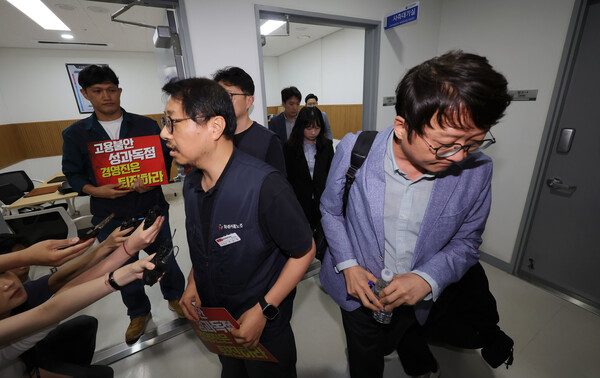
Kakao headquarters labor and management failed to reach a final agreement in a second mediation session held on May 27 at the Gyeonggi Provincial Labor Relations Commission. As a result, the Kakao headquarters union secured legal rights to strike.
Earlier, in a first mediation session on May 18, the two sides also failed to narrow differences on key issues such as the wage increase rate and the performance compensation system, and extended the mediation deadline once. Management presented multiple compensation proposals, but differences over bonuses and the institutionalisation of RSUs, or restricted stock units, were not resolved.
At the heart of the dispute is the fairness of the compensation system. The union has argued that despite improved company performance last year, compensation standards for rank-and-file employees were opaque. It has demanded clearer standards for bonus payments and that RSUs worth 5 million won be included in performance bonuses. Management did not accept this, leaving the sides deadlocked.
With the headquarters mediation ending without agreement, all five entities now have dispute rights, together with four existing affiliates: KakaoPay, Kakao Enterprise, DK Techin and XL Games. The union has already passed a strike authorisation vote on May 20 covering all five entities. With all requirements met, the possibility of the Kakao group’s first joint general strike since its founding has increased further.
Still, the union is unlikely to move straight into a full-scale strike. It is expected to decide the timing and level of collective action after internal procedures such as consolidating members, sharing affiliate-specific situations and checking management’s follow-up response. Some in the industry also see it taking at least 10 days before any actual strike. As Kakao headquarters has no precedent of a strike since its founding, the union is expected to choose its approach carefully, considering symbolism and impact.
If the dispute becomes prolonged, it could also weigh on Kakao’s push for its AI strategy. Kakao is expanding AI functions across key services such as messaging, commerce and finance around its in-house AI model, “Kanana,” and is accelerating organisational restructuring and service upgrades since the launch of CEO Jeong Shin-a (정신아)'s second-term leadership. Observers say continued internal conflict could disrupt key business schedules, including AI model development and new service launches.
Rival Naver has reached a wage agreement in three weeks of intensive bargaining this year, reducing labor-management uncertainty early and contrasting with Kakao.
Other affiliates such as KakaoBank are also in wage and collective bargaining talks, so the possibility of a domino effect spreading a headquarters strike across the group cannot be ruled out. In the industry, some see the Kakao union’s demands and management’s response as potentially serving as a benchmark for future wage and labor negotiations at platform and IT companies.
 Ho-jung Lee
lhj@d-today.co.kr
Ho-jung Lee
lhj@d-today.co.kr