
OpenAI has confirmed South Korea and Japan at the same time as Asia’s first partners for its government cyber trusted access programme (GTAC, Government Trusted Access for Cyber). They are its third global partners after the United States and Canada. It said it will open its cybersecurity programme to more countries and institutions than Anthropic.
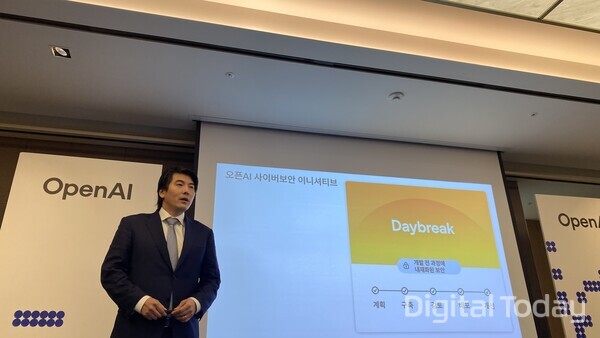
OpenAI announced a "Korea Cyber Action Plan" with those details at a press briefing on Tuesday at the JW Marriott hotel in Seoul’s Seocho district. Jason Kwon (권) , OpenAI’s chief strategy officer (CSO), said, "In terms of computing capacity, it is possible to have broader access than Glasswing." He said the goal is "to put powerful AI tools in the hands of trusted defenders."
GTAC is for governments and public institutions. It is separate from TAC (Trusted Access for Cyber), a trusted access programme for the private sector. Kwon said, "Public institutions often have requirements that differ from the private sector, so we apply a separate procedure." Both programmes operate under OpenAI’s cybersecurity initiative, Daybreak.
Institutions that join GTAC gain access to OpenAI’s latest cybersecurity-focused AI models. The main uses are vulnerability discovery and patching. Kwon said, "It is a structure that always provides the latest models, not a specific model." He said models after GPT-5.5 Cyber will also be provided to trusted defenders as quickly as possible through Daybreak.
Access to GTAC for South Korean institutions still requires an authorisation process. Once completed, the tools can be used immediately. OpenAI said Sasha Baker, head of national security policy, visited South Korea on May 18 and demonstrated its latest cybersecurity-focused models to the Ministry of Science and ICT, the Ministry of Foreign Affairs, the Ministry of the Interior and Safety, the Financial Services Commission, the National AI Strategy Committee and the Korea Internet & Security Agency (KISA), among others. On May 26, Kwon met Ryu Je-myeong, second vice minister at the Ministry of Science and ICT, to formalise cybersecurity cooperation. KISA will handle working-level tasks.
OpenAI also outlined plans to expand in South Korea’s public sector and said AI is emerging as a public good. It signed memorandums of understanding the previous day with Korea Water Resources Corp on AI cooperation for climate change and water disaster response, and with Korea Technology Finance Corp on building an AI-based technology evaluation system. Kwon said, "The long-term goal is to provide AI to more people at lower cost." He said AI is moving beyond improving productivity for individuals and companies and toward becoming a public good applied across systems a country depends on.
It will continue practical cooperation with the Korea AI Safety Institute, including safety evaluations and joint research. Kwon said, "Based on our experience cooperating with the U.S. and UK AI Safety Institutes, we will help Korea build AI trust and safety capabilities faster."
◆"Broader than Glasswing"...differentiating from Anthropic
About 50 companies are currently known to be participating in Project Glasswing, a cybersecurity consultative body run by Anthropic based on Mithos. Kwon said, "Cyber capabilities will be far more widely spread a year from now than they are today." He stressed, "Trusted defenders must secure capabilities before malicious actors." OpenAI plans to separately disclose outcomes related to TAC within days.
In the consumer market, it named Google Gemini as its main competitor. Kwon said he believes Anthropic is not focused on the consumer segment. In the enterprise market, he said Codex is growing rapidly and that rising API usage is also driving revenue.
On data security concerns, he offered two options. Kwon said, "In Korea, we already provide data residency, so processed data remains in the country." He said an option that does not store the data itself is also being operated for some customers. Both TAC and GTAC use token-based pricing. Costs are set through individual discussions with OpenAI’s go-to-market team.
In South Korea, the private-sector TAC has been in operation for about a month and a half. Kwon said, "Multiple conversations are under way with several major companies in Korea." He did not disclose specific company names.
On progress in building Stargate in South Korea, he said, "Productive discussions are under way with SK and Samsung," adding, "It is proceeding smoothly."
Kwon also disclosed the state of the South Korean market. ChatGPT currently has 900 million weekly active users (WAU) worldwide and more than 1 million enterprise customers. South Korea ranks among the global top 10 countries by WAU, enterprise customers and paid subscriptions. In South Korea, WAU for the coding tool ChatGPT Codex has increased 10-fold since the start of the year, and daily usage in the country has risen more than 30-fold since the Codex app launched. South Korea ranks among the global top five countries by Codex utilisation. More than 50 percent of Codex requests in South Korea come from non-development work such as document writing, analysis, research and operations rather than coding.
Kwon in particular said South Korea is the country best positioned for the AI transformation (AX) stage. He cited a culture of rapid technology adoption, the public sector’s proactive willingness to adopt AI, and a full-stack economy spanning semiconductors to startups. He said, "South Korea is a very important country for OpenAI," and added, "We also believe OpenAI can be an important partner in Korea’s AX."
 Seulgi Son
sageson@d-today.co.kr
Seulgi Son
sageson@d-today.co.kr