
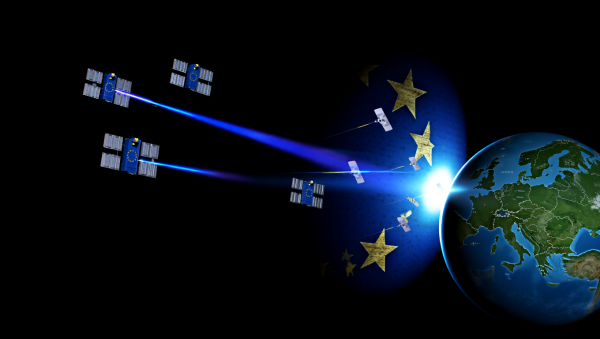
The European Union is effectively in the final stages of a plan to give European companies priority access to two-thirds of key frequency bands for mobile satellite communications.
Cryptopolitan, a blockchain media outlet, reported on May 26 that if the reshuffle is implemented, SpaceX's Starlink and Amazon's Kuiper are more likely to have to compete only within the remaining one-third of the band.
The move targets the 2 GHz mobile satellite spectrum band. It covers a paired 30 MHz band at 1980 to 2010 MHz and 2170 to 2200 MHz. It is used to connect mobile phones and vehicles directly in areas beyond the reach of standard mobile networks. The industry sees the band as a de facto core regulated frequency for direct-to-device services.
The licences are currently held by Viasat and EchoStar. Viasat secured its licence by acquiring Inmarsat, and EchoStar obtained its licence by acquiring Solaris. The two licences expire in May 2027. EU member states jointly manage the band through the European Commission, making it likely that the next allocation will also be made through a single EU-level decision.
IRIS2 is cited as the leading beneficiary candidate. IRIS2 is a next-generation satellite constellation project being built by the SpaceRISE consortium, which includes SES, Eutelsat and Hispasat. It plans to deploy a total of 290 satellites. Airbus, Thales Alenia Space and OHB are also participating as contractors.
The EU signed a 12-year contract worth about 10.5 billion euros in December 2024, including about 6.5 billion euros in public funding. Government services are scheduled to begin in 2030. UK and Norwegian companies may also be granted eligibility to participate in bidding, the report said.
The decision in Brussels is rooted in a strategic judgment aimed at reducing dependence on U.S. technology. An example cited as having heightened caution within the EU is Elon Musk's past mention of possible limits on Starlink access in Ukraine. Musk's close ties with the Donald Trump administration were also reported to have become a burdening factor.
The EU has recently expanded policies to reduce reliance on U.S. companies in strategic industries such as cloud services, semiconductor equipment and cybersecurity tools. Satellite communications is being classified as strategic infrastructure in the same category.
Thomas Regnier (토마스 르니에), a spokesperson for the European Commission, said, "In the current geopolitical environment, satellite connectivity has become a key element of resilience, security and capacity." He added that "satellite connectivity is a key pillar of technological sovereignty and security and defence," underscoring the strategic significance of the IRIS2 project.
Internal differences also existed. Some commissioners argued that the entire band should be allocated to European companies to fully exclude U.S. operators. In contrast, Henna Virkkunen (헤나 비르쿠넨), the EU's top technology official, opposed a full exclusion. The report said the compromise of prioritising two-thirds ultimately gained ground.
In that case, current licence holders Viasat and EchoStar may also be put at a disadvantage. Both are U.S.-listed companies and could be classified as non-European operators. Even with existing licences, they may have to compete only within the open one-third portion in the next allocation.
The industry sees the decision as an example of a push to strengthen Europe's "digital sovereignty" beyond a simple spectrum reallocation. Starlink and Kuiper would not be fully excluded from the European market, but analysis suggests that restricting access to the core mobile satellite band could create clear constraints on future expansion of direct-to-device businesses in Europe.
 Jinju Hong (홍진주)
hongjj@d-today.co.kr
Jinju Hong (홍진주)
hongjj@d-today.co.kr