
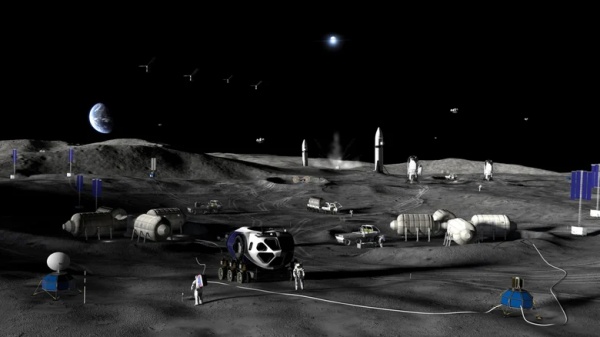
NASA has released a preliminary schedule to carry out up to 3 additional moon missions by the end of 2026.
According to U.S. technology outlet Engadget on Monday, the missions are a preparatory step toward building a permanent lunar foothold, with a focus on testing rovers and landers and surveying the lunar surface environment.
NASA carried out Artemis II, a crewed exploration mission, in April, but the mission only flew past the moon. NASA is now pushing ahead with a plan to build a long-term base on the lunar surface called Moon Base. It said the new missions are largely intended as demonstrations for that effort.
The first mission, Moon Base I, is expected to be launched after the fall of 2026. It will use Blue Origin's Blue Moon Mark 1 Endurance lander. NASA plans to send equipment, cameras and other hardware to the moon to test tools for analysing lunar ejecta and surface conditions. NASA said it recently completed tests of the Blue Origin lander to be used for the first Moon Base mission, and this month received a second-generation crewed prototype to be used in future training and testing.
Moon Base II is scheduled for late this year. In the mission, Astrobotic's Griffin lander will place Astrolab's FLIP rover on the lunar surface. The FLIP rover is expected to be used to gather driving data for development of next-generation lunar terrain vehicles.
Moon Base III will also be pursued at a separate time in 2026. Intuitive Machines' Nova-C Trinity lander will study swirl-shaped lunar terrain and will also transport payloads for the European Space Agency and the Korea Astronomy and Space Science Institute. The inclusion of equipment from the Korea Astronomy and Space Science Institute is seen as an example showing the potential for expanded international cooperation in lunar exploration.
The plan also highlighted NASA's complex public-private cooperation structure. NASA is running separate contracts for lander development, rover manufacturing and payload transport. Astrolab and Lunar Outpost have each won contracts to develop next-generation lunar terrain vehicles worth about $219 million and $220 million, respectively. Blue Origin secured about $118 million under a contract to transport the vehicles to the moon and is also developing landers to be used in future missions.
The missions are an extension of a revised schedule NASA released in February. NASA had postponed the timing for humans to return to the lunar surface to 2028. Before a crewed landing, it also plans to pursue a drone exploration mission called Moonfall to survey candidate landing sites.
Industry participants see the Moon Base missions as being more about testing and validation than simple cargo transport. The process is intended to validate landers and rovers from private companies such as Blue Origin, Astrobotic and Intuitive Machines in actual lunar conditions, and to secure surface data and candidate landing-site information needed to build a future crewed base.
In particular, as NASA expands a structure that involves private space companies and international institutions at the same time, some are raising the possibility that competition in lunar exploration could be reshaped beyond a simple national project into a global industrial ecosystem.
 Jinju Hong
hongjj@d-today.co.kr
Jinju Hong
hongjj@d-today.co.kr