
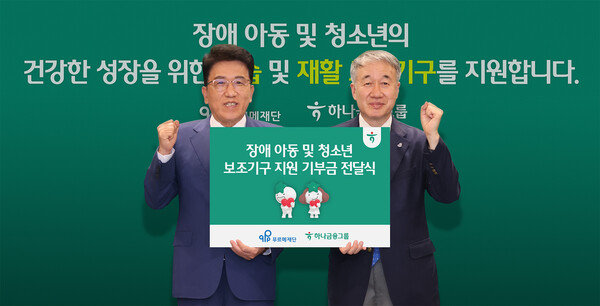
Hana Financial Group is launching an integrated support programme spanning rehabilitation, education, housing welfare, jobs and financial services to help people with disabilities in welfare blind spots enter society and become self-reliant.
Hana Financial said on May 27 it is pushing a "tailored integrated support" programme to back healthy social participation and sustainable lives for people with disabilities.
The programme was prepared to support those left in welfare blind spots despite a growing population of people with disabilities. The support areas comprise 5 sectors: rehabilitation, education, housing welfare, jobs and financial services.
First, Hana Financial will provide customised assistive devices to 300 low-income children and teenagers with disabilities through a donation ceremony for its rehabilitation and learning assistive device support project.
In education, it will offer job-linked vocational training to 85 people, including those with developmental disabilities, hearing disabilities and borderline intellectual functioning. It will build "digital practice rooms" at 3 special schools nationwide that resemble real workplaces and also run a programme to strengthen teachers' expertise.
It will also expand housing welfare support. It will renovate facilities at 20 ageing residential facilities for people with disabilities nationwide, including waterproofing, wallpapering and heating work, and provide 3 electric vehicles and 7 light cars. It plans to newly provide 5 lift-equipped light cars that can carry wheelchairs to improve mobility.
In jobs, it will work with the Korea Autism Love Association to create a complex cultural space that employs autistic baristas and artists with disabilities. It plans to provide stable jobs while supporting cultural activities.
It also plans to provide tailored financial services related to inherited assets and asset management to autistic people with disabilities and their families who have difficulty managing funds.
Ham Young-joo (함영주), chairman of Hana Financial Group, said, "We want to help children and teenagers grow up healthily and establish themselves as members of society." He added, "We will continue to work for the stable settlement of people with disabilities in society and the advancement of their rights."
 Ji-young Lee
ljy@d-today.co.kr
Ji-young Lee
ljy@d-today.co.kr