
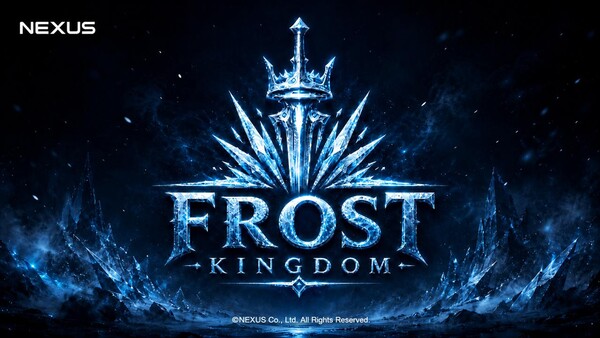
Nexthus is broadening the direction of its blockchain game strategy with its new strategy simulation game (SLG) Frost Kingdom. Until now, the focus was on onboarding into the CROSS ecosystem by combining blockchain elements with existing games. This time, it is structured as exclusive publishing of a new title developed externally. The genre is also SLG rather than a massively multiplayer online role-playing game (MMORPG). It is seen as a choice that focuses on the structural strengths of SLGs in blockchain games.
According to the industry on Tuesday, Nexthus' new strategy simulation game Frost Kingdom will hold a closed beta test (CBT) for seven days from June 4 to 10.
The key purpose of this CBT is to secure data on a multi-token tokenomics-based economic system and to verify economic balance. To that end, it will apply a payment system during the CBT and implement a policy that returns 100 percent of participants' spending as Blue Diamonds, an in-game currency, after the official launch.
The game, which bills itself as the "world's first Web3 SLG", will be released on three platforms: iOS, Android and PC. It will be serviced in a domestic version and a global blockchain version. The developer is an external studio based in China, and Nexthus will serve as exclusive publisher.
SLG aligns with blockchain economics and structure.
Jang Hyun-kook (장현국), CEO of Nexthus, said, "If MMORPGs delivered results on blockchain based on economic structures, SLGs have even more sophisticated economic structures, so combining them with blockchain can generate greater synergy."
Some elements blockchain seeks to implement also appear in similar form within SLG game structures. The two structures align in three aspects: resource economies, collective governance and scarce assets.
First is the resource economy. In major SLGs such as Whiteout Survival and Last War: Survival, multiple resources including food, wood, iron and gold are continuously produced and consumed, and used for alliance-level resource allocation and war preparation. The economic circulation structure blockchain aims to implement through tokens operates in a similar way in SLGs through in-game resource production and consumption and alliance-level distribution.
Collective governance is similar as well. In SLGs, alliances of 50 to 60 people manage shared resources and coordinate wars around a command structure. It resembles the collective decision-making structure pursued by blockchain DAOs (decentralised autonomous organisations). It does not apply on-chain voting and smart contracts, but it has a similar structure in terms of collective decisions and operation of shared resources.
Scarce assets are similar too. Heroes and equipment, rare titles and territory are limited in quantity, held for long periods and form high value among users. In-game items in SLGs can be linked to non-fungible tokens (NFTs) in that they create scarcity and long-term holding value within the game.
This also contrasts with the failure of the existing play-to-earn (P2E) model. While some blockchain games that presented rewards as a reason to play faced a vicious cycle of user departures and token price collapses, in SLGs war and alliance competition themselves are the motivation for participation, and tokens and NFTs are closer to adding ownership on top of that. Users stay because the game is fun first, and blockchain is layered on top.
Market trends also support this view. According to Sensor Tower, 2024 mobile strategy genre revenue was $17.5 billion, surpassing RPGs ($16.8 billion) for the first time. In the first half of 2025, the strategy genre also led RPGs, posting $10.6 billion versus $9.3 billion, and was the only genre in which revenue, downloads and usage time all grew at the same time. In South Korea, in January 2026 the 4X strategy genre surpassed MMORPGs in monthly revenue for the first time in nine years.
Based on the view that SLGs structurally align with blockchain, Nexthus set the genre as the next pillar in its blockchain game push. Frost Kingdom is its first execution.
A new title, a Chinese developer and merge mechanics: the specific approach to the SLG blockchain push.
Nexthus' approach to targeting SLGs this time differs from existing blockchain game launch methods in three ways.
First, it is a new title rather than a reuse of existing intellectual property (IP). Nexthus' existing blockchain games, such as Seal M on Cross, were re-released by combining blockchain elements with games that already had a service history. Frost Kingdom is a new title with a separate global blockchain version. Compared with adding blockchain elements to an existing game after the fact, it leaves more room to design the game structure and on-chain economy together.
Choosing a Chinese studio as the developer is also part of the SLG strategy. Among the top 100 Chinese games by overseas revenue, the share of SLGs is 49.96 percent, close to half. SLG hits by Chinese developers, including Last War, Whiteout Survival and Kingshot, are also producing results in the global market. With development experience and know-how in the SLG genre concentrated in China, directly publishing a new Chinese title is seen as a choice to secure competitiveness in the genre.
In game structure, it introduced merge mechanics. Unlike classic SLGs that adopt complex, stats-based growth systems, it enables fast growth by combining buildings and troops. While featuring a collection and development system with around 100 types of units and heroes in four tiers, it aimed to lower the initial barrier to entry. The broader the user base, the more room there is for a blockchain economic structure to function in practice.
AI operations automation to be added, with gameplay the key.
Nexthus is adding AI agent-based operations automation to its SLG-and-blockchain combination. It plans to apply the technology to Frost Kingdom first. Its AI agent battle platform Cloroyal (formerly MultiRoyal), launched in the first quarter, has generated more than 25 million agents since launch. Frost Kingdom will be the first case of transplanting that capability into actual game service operations.
Still, the success of a new SLG is not guaranteed by structural logic alone. The global SLG market includes established players that have recorded cumulative revenue of several billion dollars over years. A new title must compete in the same genre while also carrying the variable of blockchain. Key variables are how naturally alliance-based governance integrates with an on-chain structure, and whether the game itself can retain users even without tokens.
Jang said, "SLGs are a genre in which economic interactions between players, such as resource production and consumption and territorial competition, are the core, and combining them with blockchain tokenomics can generate the strongest synergy." He added, "Based on the economic data collected in this CBT, we will advance the tokenomics design before the official launch."
 Ho-jeong Lee
lhj@d-today.co.kr
Ho-jeong Lee
lhj@d-today.co.kr