
Samsung Asset Management has moved to the center of the fee competition after setting total fees for single-stock leveraged exchange-traded funds (ETFs) tied to Samsung Electronics and SK Hynix at the highest level in the industry. As ETF issuers continue to cut fees, Samsung Asset Management stressed that investors should look at liquidity, the gap between bid and ask quotes, and hidden cost-saving effects from an in-kind creation structure rather than total fees alone.
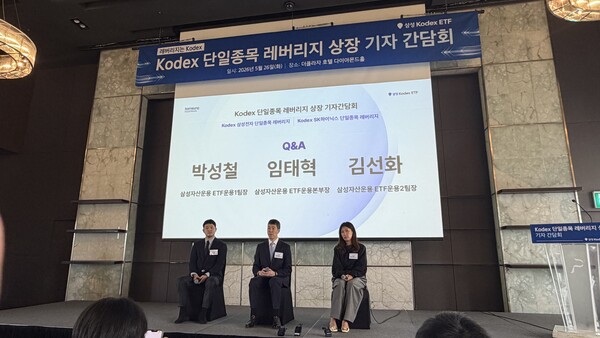
On May 26, Samsung Asset Management held a press briefing on single-stock leveraged ETFs and focused on explaining the cost structure investors feel in practice.
The ETF market has recently seen ongoing competition among asset managers to cut total fees. From an investor's standpoint, the lower the total fee, the smaller the cost burden appears to be.
But because leveraged ETFs are products with a higher share of short-term trading than long-term holding, it is difficult to judge cost advantages based only on total fees, Samsung Asset Management said.
Lim Tae-hyuk (임태혁), head of ETF management at Samsung Asset Management, said total fees and commissions are clearly different concepts. He said total fees are reflected daily in a fund's net asset value (NAV), while a spread means buying more expensively and selling more cheaply in a single trade.
He added that investors need to understand the unseen costs that arise the moment they trade an ETF with a wide spread.
Samsung Asset Management introduced the KODEX leveraged ETF's spread at about 4 basis points, or 0.04 percent, as of a recent reference point. It also said leveraged inverse ETFs turned over 120 times this year based on trading volume relative to listed shares, and have turned over an average of 71 times a year since 2020.
Converted into trading days, the calculation implies an average holding period of only about 4.4 days. With frequent short-term trading, liquidity and quote spreads can affect actual returns more directly than total fees.
Another cost-saving feature Samsung Asset Management highlighted for the new products is an in-kind creation structure. The company said investors need to distinguish between the ETFs being spot-based and being in-kind creation products at the same time.
Spot-based leverage is a management method that holds physical shares in a portfolio, while in-kind creation means exchanging shares instead of cash during ETF creation and redemption.
In a typical cash creation leveraged ETF, a securities firm pays cash to the asset manager, which uses the cash to buy shares and futures to build the portfolio.
At redemption, the asset manager must sell the shares it holds to raise cash. Trading commissions and securities transaction tax can arise in that process.
In an in-kind creation structure, by contrast, a securities firm transfers shares directly to the asset manager at creation, and at redemption the manager returns shares to the securities firm without selling them. The asset manager can reduce spot trading, which can cut trading commissions and securities transaction tax, Samsung Asset Management said.
Samsung Asset Management said it expects annual trading cost savings of more than 1 percent versus a cash creation spot leveraged ETF through this method.
A question on the level of total fees also came up in a question-and-answer session. Lim said that if his firm's product total fee is assumed to be 30 basis points, or 0.3 percent, dividing that by 12 months puts the monthly holding cost at about 2.5 basis points.
He said leveraged management is not a product that is listed and left alone, but one that requires watching the secondary market every day and communicating with liquidity providers, explaining the rationale for the fee level.
He also said the brokerage commission rates for leveraged ETFs disclosed by the Korea Financial Investment Association should be considered as well. Lim said about 0.2 percent in fees is visible, but investors should trade after carefully weighing hidden costs, too.
Competition in single-stock leveraged ETFs is unlikely to end with total fee cuts alone. Even for the same two-times products tied to Samsung Electronics and SK Hynix, the costs investors actually feel can differ depending on the number of liquidity providers, quote spreads, the creation and redemption structure, and an asset manager's trading capabilities.
From an investor's standpoint, it is necessary to look at trading value, the gap between best bid and ask quotes, premium and discount rates, and tracking error rather than comparing only product names and total fees.
In particular, because leveraged ETFs often see market orders during periods of high volatility, trades can be executed at more unfavorable prices than expected when quotes widen.
Lim said leverage is not a long-term investment product but one used to respond to market conditions in the short term. He said investors should check liquidity and spreads that allow immediate trading at a desired price, as well as total fees.
 Oh Sang-yeop
yub@d-today.co.kr
Oh Sang-yeop
yub@d-today.co.kr