
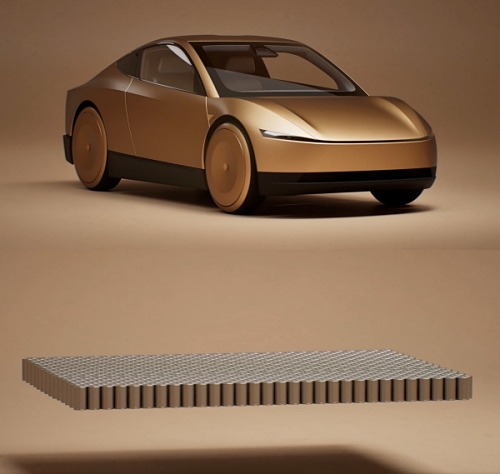
Tesla's robotaxi-only vehicle, the Cybercab, has recorded the highest power efficiency among electric vehicles disclosed so far. The industry also sees the record as more closely tied to future robotaxi profitability than to competition among passenger EVs.
Electrek reported on May 22 that Lars Moravy (라스 모라비), Tesla's vice president of vehicle engineering, said the Cybercab's officially certified efficiency is 165 Wh/mi. He said it was not a simple target but a figure Tesla confirmed under actual certification standards.
A comparable model, the Lucid Air Pure rear-wheel-drive version, is known to be about 230 Wh/mi. Tesla's Model 3 rear-wheel-drive is 240 Wh/mi, and Hyundai Motor's Ioniq 6 SE rear-wheel-drive is known to be around 241 Wh/mi. Based only on power consumption needed to travel the same distance, the Cybercab uses far less energy than existing EVs.
Industry watchers, however, say it is difficult to compare the Cybercab on the same footing as a regular electric passenger car. The Cybercab was designed as a two-seat robotaxi-only vehicle without a steering wheel or pedals.
The vehicle adopts a teardrop-shaped design to minimise air resistance, and its battery pack capacity is reported to be designed at under 50 kWh. Electrek assessed this by saying, "The expression 'the most efficient EV ever' is technically correct, but it is similar in some ways to comparing motorcycle fuel economy to a sedan."
Tesla claims that this structure allows it to secure a driving range of about 300 miles with a relatively small battery pack of 50 kWh or less.
General EVs sold today must meet requirements including a four- to five-seat layout, cargo space, a steering wheel, pedals and various crash safety regulations. By contrast, the Cybercab is seen as removing many of these elements and focusing on transporting two passengers at minimal cost.
For this reason, the industry sees the efficiency record as more meaningful for robotaxi business viability than for the vehicle's product appeal. Energy costs are seen as one of the key operating expenses for ride-hailing services.
Using the average U.S. electricity price of about $0.16 per kWh, the Cybercab's energy cost is calculated at about $0.026 per mile. Tesla's Model 3 is about $0.038, and Hyundai's Ioniq 5 is about $0.048.
The industry sees that in a large robotaxi fleet driven tens of thousands of miles or more, such differences could lead to a significant cost gap over the long term.
A smaller battery pack is also cited as an advantage in terms of economics. It can reduce battery costs and also help shorten charging times. Tesla previously presented a target price for the Cybercab at about $30,000, and its high power efficiency is assessed as one of the key factors that makes that possible.
Production has already begun. Tesla said it started Cybercab production at its Giga Texas plant in the United States in April. The industry expects the pace of initial production ramp-up to be limited.
Production has already started. Tesla confirmed it began Cybercab production at Giga Texas in April. The initial ramp-up is expected to be slow. Fully unsupervised self-driving, a prerequisite for business expansion, remains unresolved. In February, the first vehicle without a steering wheel came off the production line, but the accident rate of the current supervised robotaxi fleet is about 4 times higher than that of human drivers, the outlet reported.
Organisational stability is also a variable. The Cybercab project is reported to be experiencing a leadership vacuum after 3 key senior leaders left the company in recent months.
The 165 Wh/mi figure is assessed as a clear technical achievement, but its real business meaning depends on whether Tesla can actually solve the fully autonomous driving problem, according to the analysis. Industry watchers say that if autonomous driving commercialisation does not happen, the current ultra-high efficiency record could also remain of limited significance.
 Jinju Hong
hongjj@d-today.co.kr
Jinju Hong
hongjj@d-today.co.kr