
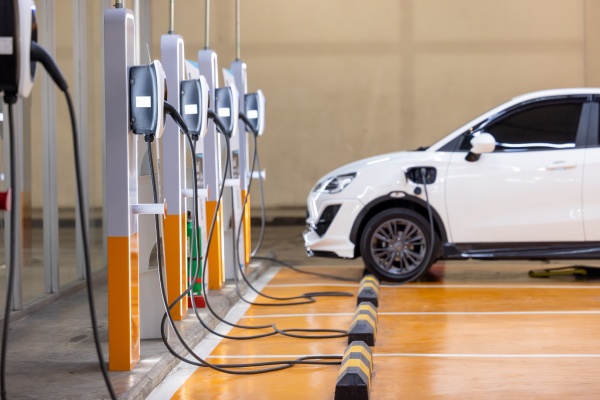
In the electric vehicle market, “range anxiety” is easing as a key concern. In the era of ultra-fast charging, a new problem is emerging: charging for longer than necessary and driving up costs. Volvo has even coined the term “hotdog anxiety” for it.
InsideEVs reported on May 24 that Anders Bell (앤더스 벨), Volvo's chief engineering and technology officer (CTO), said at the unveiling event for the EX60 in New York, “We discovered a new phenomenon.” He called it “hotdog anxiety replacing range anxiety.”
It refers to situations where a car is already sufficiently charged while the driver eats or rests during charging, but the driver continues charging and spends unnecessary money. Bell said that in just a few minutes, “you end up charging an extra $25 worth, and then it becomes a very expensive hotdog.”
The shift comes amid sharp improvements in EV charging speeds. In the United States, public fast-charging networks are expanding quickly, and high-output chargers are becoming more common. As more vehicles adopt 800-volt architectures, charging times have fallen sharply from the past.
Volvo said the EX60 can charge from 10 percent to 80 percent in about 16 minutes using a 350-kilowatt charger. BMW's new iX3 supports charging of up to 400 kilowatts and can add up to 185 miles of range in 10 minutes, it was explained. The Mercedes-AMG GT is also targeting about 11 minutes to charge from 10 percent to 80 percent using up to 600 kilowatts. The industry sees charging times steadily approaching the refuelling time of internal combustion engine vehicles.
Volvo says in this environment, not every driver needs to charge to 80 percent every time. For users who can charge overnight at home, it may be more efficient even on long trips to top up briefly with only the power needed to get home. Analysis also suggests this shows the market's focus is shifting from simply “how far can you go” to “when and how much charging is most economical.”
Some point out that the phenomenon does not apply uniformly across the overall EV market. Volvo did not disclose specific statistical data, and the report said it was still too early to generalise.
Vehicles capable of ultra-fast charging are also still limited. Hyundai Motor's Ioniq 5 and Kia's EV6, based on 800-volt systems, can charge from 10 percent to 80 percent in around 20 minutes, but many mass-market EVs still need 30 to 40 minutes. Some Tesla models and drivers of other mid- to low-priced EVs have relatively longer charging times, which could mean there may not be a high likelihood of unintended overcharging or additional costs.
Housing conditions are also cited as an important variable. Users with low access to home charging, such as apartment residents, still have to rely heavily on public fast charging. In such cases, securing longer driving range from a single charging session may be a more realistic choice than minimising time spent charging.
The industry sees the centre of competition in EVs likely shifting from simply increasing battery capacity to optimising real-world costs and charging efficiency.
Global automakers are currently presenting around 300 miles of driving range as a de facto baseline, and some companies are competing with targets of more than 400 miles. If charging speeds continue to rise, analysis suggests EV drivers are entering an era in which they first calculate “how little to charge before leaving” rather than how far they can go.
 Jinju Hong
hongjj@d-today.co.kr
Jinju Hong
hongjj@d-today.co.kr