
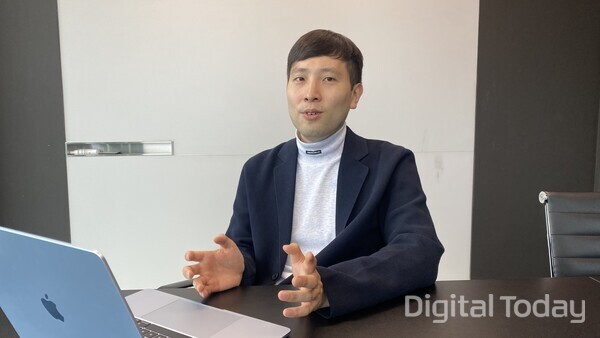
"In the AI era, the winner is whoever takes over AI answers, and what the winner writes becomes the truth."
Across CEO Lee Jae-hong (이재홍) says companies that pre-empt AI answers will hold industrial leadership in the AI era.
Across develops the generative engine optimisation (GEO) solution GPTO and the AI mention ranking aggregation platform GenRank. It set up the company in August last year after securing investment from local large accelerator Primer and blockchain and AI venture capital firm Hashed at the methodology stage. It has five members including the CEO. Monthly sales topped 1 billion won in April, reaching break-even.
Lee started the GEO business after losing his job. A KAIST industrial engineering graduate, he began as a data scientist at Cheil Worldwide and built 10 years of planning and marketing experience. He later worked on contract in sales and marketing at a U.S. company and a digital asset issuer. His monthly pay alone was 15 million won. One company offered him a full-time job, but negotiations collapsed because the contract compensation he received in coins exceeded the full-time salary.
He decided to start a business and travelled around the world to take part in hackathons. Finding a technical co-founder was not easy. After two failures, he decided to learn development himself. He moved his base to Southeast Asia, where prices were lower, and took online classes for 10 hours a day. After a year, as code began to make sense, the AI coding tool Cursor came out. App development sped up. He built and launched countless apps, but none succeeded.
The idea for GPTO came around that time. He was preparing for a blockchain-related hackathon with prize money in mind. While doing research, he saw AI answers that were far removed from reality. From Lee's view after five years in the industry, there was a lot of incorrect information. As he began asking why, he had a eureka moment. "AI ultimately answers based on what is on the internet. What is on the internet determines AI answers," he said.
That led to the thought: "If I plant what I want on the internet, won't AI use it in its answers?" At the time, the terms AEO and GEO had not yet been established. He set the methodology over three months of repeated trial and failure.
GPTO is the productisation of that methodology. It is a solution that produces the desired answer when users ask AI a specific question. AI handles the entire workflow, from strategy to content distribution. "Every week we ask an LLM the questions our clients have to monitor, pull the original sources, analyse the status of our company and competitors, and design optimisation," he said. "Based on that, we distribute to more than 400 sites, and AI does all of it," he said.
He explained it as being like "spoon-feeding answers to AI". "When AI looks around a street lined with information, we set the environment so it has no choice but to pick up that information by putting up a flashy outdoor sign," he added.
He said GEO is based on limits in computing resources. It would be accurate if AI searched all information every time it answers, but that would require enormous resources. "Algorithms are applied to produce accurate answers with fewer resources," Lee said. "GPTO sticks to a fundamental method that works regardless of which model comes out, so it is not affected by updates," he said.
It has about 500 clients, including large and global companies such as Daehong Communications, AWS and CJ. It charges a monthly subscription in proportion to the target number of questions. Performance is measured through a monitoring dashboard that tracks weekly mention rates by question and by model. It aims to be a solution provider rather than an agency. It currently does some sales directly, but plans to have sales partners handle all of it in the future.
Lee says being AI native must be reality, not a concept. His credo is to "use AI only where AI is best". "You have to assume AI is better than me to do things beyond imagination with AI," he said. "We initially tried automating things like YouTube Shorts with AI, but it did not deliver results, so we shifted to collaborating with veteran producers in the industry," he said.
Efficiency comes first in keeping the organisation lean. "The more experience someone has, the harder it is to abandon the habits they worked with," Lee said. "Since AI does the work anyway, there are no criteria for experience or major in hiring employees. Even university students are possible. We only look at learning ability and attitude. Then anyone can deliver performance," he said.
Lee stressed that now is the golden time for corporate GEO strategies. "Search engine optimisation (SEO) was also easy in the early days. What you planted then survived even when algorithms changed," he said. "If you do it now, there is a high chance it will survive long term, no matter how things change," he said.
The short-term goal is for GPTO to become synonymous with GEO. It also plans to secure partners in Southeast Asia, Japan and the Middle East within the year. "Hashed is helping us secure overseas sales partners," Lee said. "The GPTO solution works the same regardless of language or country," he said.
Over the medium to long term, he aims to grow GenRank into a global standard for AI answer ranking aggregation. The strategy is to bring media companies into a marketplace. It would be a structure where companies can look at the index to see their AI exposure status versus competitors and immediately buy optimisation services.
 Son Seul-gi
sageson@d-today.co.kr
Son Seul-gi
sageson@d-today.co.kr