
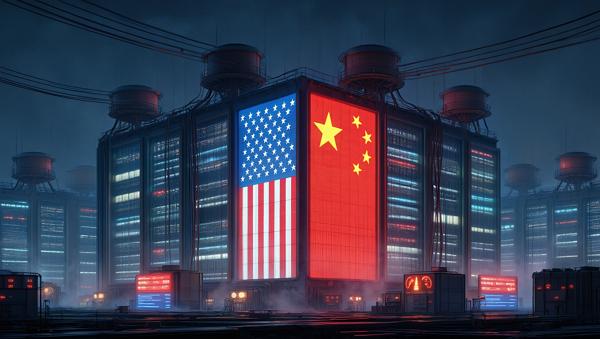
Large amounts of money are flowing into the artificial intelligence industries of the United States and China, intensifying investment competition between the two countries. On May 24 local time, blockchain media outlet Cryptopolitan reported that global investment in AI startups reached $255.5 billion in the first quarter of 2026, while Chinese AI ventures separately raised more than 110 billion yuan.
China is accelerating efforts to foster AI, semiconductors and advanced manufacturing backed by government-led funding. In a Beijing news conference in February, Fan Xiaodong (판샤오둥), secretary-general of China’s Ministry of Science and Technology, said the country launched a national venture capital guidance fund focused on early-stage, small-scale and long-term investment and hard tech companies. Its total size is about 1 trillion yuan.
Government-linked investors participated in more than 140 AI deals in 2025. That is a sharp increase from about 10 deals a year before 2018. Chinese authorities, together with financial institutions and local governments, also created various funds worth more than 350 billion yuan, including a technology industry integration fund and secondary market funds.
DeepSeek is pushing ahead with its first external investment round led by the China Integrated Circuit Industry Investment Fund. DeepSeek’s valuation rose to $20 billion from $10 billion in April and was estimated at $45 billion to $50 billion in early May. Moore Threads raised $720 million at a $4.1 billion valuation in February 2025. Moonshot AI raised $700 million at a $10 billion valuation in January 2026, and StepFun was reported to have raised $717 million.
The United States and China are also moving to protect domestic industries as they expand investment. The United States banned its investors from investing in Chinese AI and semiconductor companies in January 2025. China applied similar restrictions in late April. The National Development and Reform Commission instructed Moonshot AI, StepFun and ByteDance not to accept U.S. capital without government approval after Meta’s $2 billion acquisition of Manus.
The Trump administration claimed Chinese research institutes are distilling U.S. AI models at industrial scale. A White House memo proposed four measures in response, including sharing information related to distillation tactics and defensive coordination with U.S. AI companies. Anthropic also claimed DeepSeek, Moonshot AI and Minimax misused its models.
Funding inflows continued despite tighter regulation. Chinese private market deals totaled 2,568 and 234.4 billion yuan in the first quarter of 2026. Over the same period, foreign-currency deals in China more than doubled from a year earlier to 210, and disclosed investment amounts jumped 495 percent to 67.3 billion yuan. In the United States, investment in the first quarter of 2026 exceeded the full-year total of $254.4 billion in 2025. OpenAI, Anthropic and xAI accounted for more than two-thirds of the total.
The two countries have different investment approaches, but AI development is speeding up in both. Chinese large model companies cut iteration cycles to less than three months by 2026, and a Stanford University report saw the performance gap between the top U.S. and Chinese AI models as effectively narrowing.
 Choo Hyun-woo
cookinpapa@d-today.co.kr
Choo Hyun-woo
cookinpapa@d-today.co.kr