
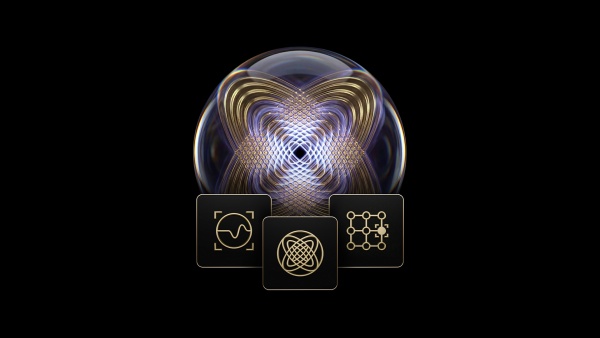
Nvidia has unveiled an open-source artificial intelligence model family called Ising to calibrate quantum computers and correct errors. It aims to use AI to address key bottlenecks that have hindered commercial quantum computing.
SiliconANGLE reported on April 14 that Nvidia said Ising would be used by research institutions and companies to develop quantum computers capable of handling large-scale applications.
Quantum computers need to reliably handle millions of qubits to move into practical use. But qubits are vulnerable to changes in the external environment and noise, and errors are frequent, making real-time calibration and error correction essential as systems scale. Nvidia chose decoding and calibration as the first application areas to address this bottleneck.
Jensen Huang (젠슨 황), Nvidia's chief executive, said, "AI is essential to making quantum computing practical," and added, "Through Ising, AI will take on the control plane of quantum devices, meaning it will serve as an operating system." He also presented a vision of converting fragile qubits into a scalable and reliable quantum-GPU system.
Ising consists of two core models. Ising Decoding is a model for quantum error correction and is offered in two versions based on a three-dimensional convolutional neural network, one optimised for speed and the other for accuracy. Nvidia said the model is up to 2.5 times faster than the existing open-source standard PyMatching and its accuracy is three times higher.
Ising Calibration is a model that adjusts and measures physical control signals to optimise system state. It handles control signals such as microwaves and lasers and corrects for noise over time, hardware instability and parameter drift. Based on a vision-language model, it runs an AI agent that interprets measurements from a quantum processor and automates ongoing calibration work.
Deployments are also under way. Ising Decoding has been adopted by Cornell University, Sandia National Laboratories, UC San Diego and UC Santa Barbara, while the calibration model is being used by companies and research institutions including IonQ and IQM.
Nvidia also released guides that include quantum computing workflows and training data, along with Nvidia NIM microservices. Developers can use them to customise models for different hardware environments and run them directly on internal systems to protect sensitive data.
Nvidia defines Ising not as a single model but as a starting point toward "quantum-GPU integrated supercomputing". That has put the spotlight on how much AI can improve error correction and device calibration, problems that have blocked commercial quantum computing.
 Jinju Hong
hongjj@d-today.co.kr
Jinju Hong
hongjj@d-today.co.kr