
[DigitalToday reporter Jinju Hong] DJI’s ultracompact wearable camera Osmo Nano is being assessed as more useful as a device for recording everyday vlogs than as a sports action camera.
On April 13 local time, Japan’s ITmedia said long-term use of the Osmo Nano showed strengths for vlogging in its hands-free shooting structure and detachable monitor.
The Osmo Nano was released in September last year. In the wearable camera market, Insta360 had built its presence first, and the Osmo Nano can be seen as DJI’s full entry into this area. The product’s nature is closer to an action camera, but a cited feature is that actual use is more aligned with everyday shooting than sports.
The key is portability and how it is worn. The camera body is the smallest among DJI products, weighing 52 grams and measuring 57 by 29 by 28 mm. It is designed to be easy to secure to clothing. After placing a magnetic neck strap inside clothing, bringing the camera close fixes it in place with strong magnetism. Users can keep filming without using their hands by pressing only the record button. This is analysed as more suitable for everyday recording than for sports shooting.
Shooting performance is also solid for a small device. It has a 1/1.3-inch CMOS sensor and a 143-degree ultra-wide-angle lens, supporting video recording up to 4K at 60 fps, with 4K at 120 fps slow motion and 10-bit D-Log M also available. Night shooting, however, was assessed as limited compared with the existing Osmo Pocket series or action cameras that use larger sensors.
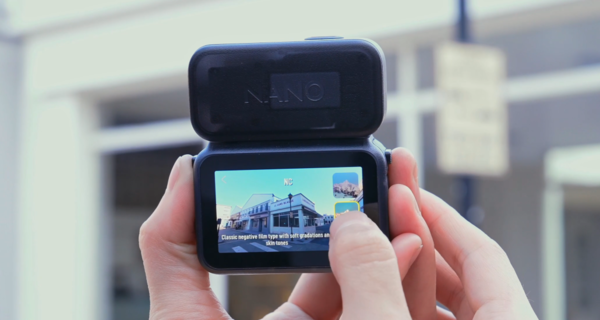
The product’s configuration was also cited as a differentiator. The Osmo Nano comes in a two-piece form split into the camera body and a “Vision Dock”. The dock has a 1.96-inch OLED touchscreen and can connect to the camera via Wi-Fi to check the live view. In particular, users can keep the camera fixed to the chest while holding the dock to check framing, and this was assessed as more convenient than existing action cameras.
In everyday shooting, this structure stands out even more. For example, when filming a meal, users can place the dock on a table and check the screen while filming naturally. With a pan-focus design, however, the minimum shooting distance is 35 cm, limiting close-up shots such as food close-ups.
Its range of use is relatively broad. The camera alone supports waterproofing to a depth of 10 metres, enabling underwater filming, and it can use various mounts to capture high angles or distinctive viewpoints. Underwater, however, wireless connections are cut off, making real-time monitoring through the dock difficult, which was pointed out as a limitation.
Overall, the Osmo Nano is assessed as a product that has action camera performance while offering an actual user experience closer to vlogging. Centered on two features, hands-free filming and a detachable screen, it is interpreted as an example showing the possibility of wearable cameras expanding as tools for recording everyday life.
 Jinju Hong
hongjj@d-today.co.kr
Jinju Hong
hongjj@d-today.co.kr