
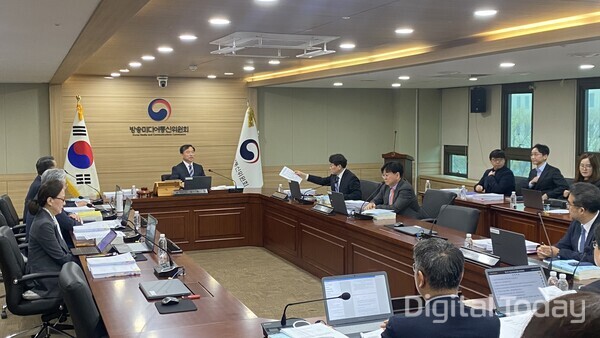
The Broadcast Media Communications Commission held its first plenary meeting since its launch. It ended a six-month administrative vacuum since its launch in October and handled 23 backlogged items, including 12 resolutions and 11 reports.
At the commission's first plenary meeting of 2026 held on April 10 at the Government Complex Gwacheon, Chairman Jong-chul Kim (김종철) said the meeting would be a starting point for the body to return to its role as a guardian of the constitution and a fair media order. He said it placed on the agenda proposals to amend enforcement decrees tied to the three broadcasting laws again and items including reauthorisation for broadcasters, considering urgency, the importance of the issues and the maturity of deliberations.
The commission handled 12 resolution items, focusing on reauthorisation and renewal approvals for broadcasters. It approved reauthorisation for 150 stations for 2024 to 2025 (first half), covering 11 terrestrial broadcasters including KBS and five community radio broadcasters. The licence validity period had already expired, but processing had been stalled due to the commission's hiatus. Under the review results, 40 stations scoring at least 700 points out of 1,000 were granted five-year terms, while 93 stations scoring 650 points or more but below 700 were granted four-year terms. Seventeen stations at three companies, including TBS, that scored below 650 will have their reauthorisation decided after a hearing process. Key review items for TBS are improvement plans for operational capability and securing funding. The commission did not separately disclose the review scores.
Cable TV saw mixed results. Geumgang Broadcasting received a seven-year reauthorisation. Korea Cable TV Pureun Broadcasting fell far short of the benchmark score and will be subject to a final decision after a hearing. Its record, including breach of trust by its largest shareholder and failure to comply with reauthorisation conditions, held it back. Reauthorisation and renewal approval reviews under the Broadcasting Act comprehensively assess a broadcaster's ability to fulfil public responsibility, fairness and public interest, broadcast evaluation results, the number of corrective orders and whether it violated laws and regulations. If a broadcaster falls short of the benchmark score, conditional reauthorisation or refusal is possible after a hearing. The hearing for Pureun Broadcasting is scheduled to be held in May.
It also approved basic and detailed plans for reauthorisation and renewal approvals for satellite broadcaster KT Skylife, five relay wired broadcasting operators including Hyundai Cable Broadcasting, and 12 TV and data home-shopping operators. A review committee will begin operating next month.
Public broadcaster governance reform begins; scope of programming committee staff becomes issue
It also addressed the amended three broadcasting laws, promulgated in August last year but still lacking enforcement decrees and rules. The changes focus on procedures for appointing directors and presidents at public broadcasters including KBS, MBC and EBS, and on strengthening programming independence. Once the relevant enforcement decrees and rules are finalised, the commission will oversee procedures to reform public broadcaster governance, including selecting organisations to recommend directors and running public calls. At the meeting, draft amendments to the Broadcasting Act enforcement decree and rules were tabled as a report item rather than for a vote. The stage is to share the content before a legislative notice, and the drafts must be finalised through review by the Ministry of Government Legislation and a Cabinet meeting. Reform of public broadcaster boards can begin only after an enforcement decree, which is a presidential decree, is issued.
The issue is the scope of staff on programming committees. The amendment limits staff to those directly participating in coverage, reporting, production and programming, and excludes managers at department head level and above. The Citizens' Coalition for Fair Media opposes the change, saying it is intended to exclude technical and management staff from programming committees. On selecting organisations to recommend directors, it set basic requirements such as being a non-profit corporation established for at least five years, and introduced public recruitment and screening systems to secure independence.
However, commissioners expressed a burden in handling the three broadcasting laws with one seat vacant. Standing commissioner Shin-hwan Ryu (류신환) said the National Assembly should quickly recommend the remaining member if the policy is to be pursued with consensus among all seven members, and said it is not appropriate to wait blindly in a situation where it is unclear when the recommendation will come. Kim said the body was effectively starting operations with a six-member system and said social public discussion would take place after the legislative notice. He said it would strongly urge the National Assembly again over the vacancy.
Follow-up after handset distribution law repeal; transmission qualification certification to take effect in September
The meeting also set grounds for pushing follow-up policies, including establishing measures to create a sound handset distribution environment that the commission is preparing.
The handset distribution law was repealed on July 22 last year, but user protection provisions were transferred to the Telecommunications Business Act. Obligations to disclose subsidies and the cap on additional subsidies of 15 percent were removed, while unfair discrimination based on region, age and physical conditions is prohibited. The commission approved amendments to the related enforcement decree and the repeal of two notices and revision of seven others, completing the legal basis about eight months after the repeal. It said detailed discrimination standards will be finalised after forming a consultative body based on the enforcement decree.
It also approved subordinate rules tied to a transmission qualification certification system to prevent illegal spam. The notice includes certification standards covering 16 items in five areas, including multi-factor authentication and a forbidden-word blocking system. Under the Telecommunications Business Act, text message resale operators will be able to operate only if they obtain transmission qualification certification, and the commission will directly inspect and manage whether they meet certification requirements. Operators failing to meet the standards will be forced out through cancellation of certification. The system is scheduled to take effect in September.
In other decisions, the commission imposed penalty surcharges and fines on 373 businesses for violating location information regulations, and approved a two-month waiver of TV licence fees for residents affected in special disaster zones from heavy rain in July to August last year. It also handled administrative measures including reorganising items subject to written resolutions and revising a notice on access rights to broadcasting for people with disabilities.
 Seulgi Son
sageson@d-today.co.kr
Seulgi Son
sageson@d-today.co.kr