
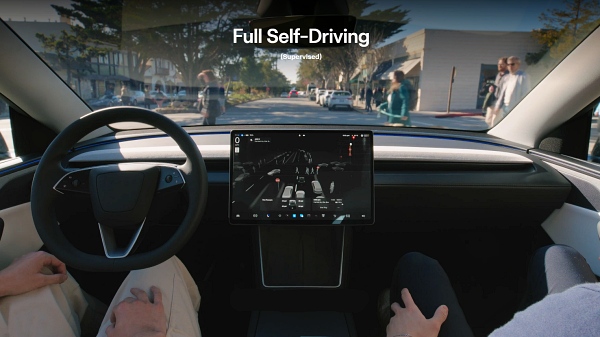
[DigitalToday reporter Yoonseo Lee] Tesla CEO Elon Musk has again claimed that v15, the next version of Tesla’s driver-assistance software Full Self-Driving (FSD), will be much safer than human drivers.
Electrek, an electric-vehicle outlet, reported on April 9 that Musk replied on X, formerly Twitter, to a user post reviewing FSD v14.3. "V15 will far exceed human levels of safety, even in complex situations," he said.
Musk also said the current v14 line would be improved with gradual updates. The remarks are not new. In November 2023, he said supervised FSD was "much safer" than human drivers and that v12 would greatly exceed human safety even without supervision. In August 2025, he said v14 would "definitely" be better than humans and mentioned that v15 could potentially reach 10 times the level of safety.
The problem is that released versions have not backed those promises. v12 remained a Level 2 system requiring constant supervision even after release. The recently released v14.3 reflected some improvements but still required driver supervision, and issues such as hallucinations and irregular behavior continued to appear.
There is also not enough evidence to prove safety. Tesla is not disclosing data on FSD disengagement interventions, detailed breakdowns of crash severity, or its safety comparison methodology. It has also not produced peer-reviewed safety research comparing FSD with human drivers under the same conditions. Musk has previously claimed FSD is 10 times safer than humans, but critics have raised methodological problems in Tesla’s own comparisons, including differences in road types, vehicle model years, driver groups and crash definitions.
Regulatory risks are also continuing. The U.S. National Highway Traffic Safety Administration has been investigating problems in which FSD fails to respond appropriately in environments with limited visibility, and the probe has expanded to 3.2 million vehicles. Separately, an investigation is also under way into possible traffic law violations such as running red lights and entering opposing lanes. There are currently 3 federal investigations into FSD under way at the same time.
Waymo was mentioned as a comparison. Based on data from 56.7 million miles (about 86.7 million km) of driverless driving, Waymo disclosed reviewed materials saying it reduced injury crashes by 85 percent and crashes involving serious injuries or worse by 90 percent versus human drivers on the same roads. Tesla, by contrast, has yet to present publicly verified data at the same level.
Attention has also returned to Musk’s repeated promises on self-driving. He said full self-driving would be possible by 2018, a self-driving U.S. cross-country trip in 2017, 1 million robotaxis in 2020, and unsupervised FSD by June 2025, but they have not been realised. FSD currently sold still remains a Level 2 driver-assistance system that requires drivers to keep their hands on the wheel and supervise continuously.
Tesla released v14.3 this week, touting a rewrite of its artificial intelligence compiler and a 20 percent improvement in response speed. But as Musk himself has acknowledged that further updates are needed for the current version, market attention is likely to focus less on the v15 release itself than on whether Tesla will provide actual safety data at that time.
Tesla V14.3 self-driving review. The point releases will bring polish. V15 will far exceed human levels of safety, even in completely unsupervised and complex situations. https://t.co/s4UK9RWw9f
 Yoonseo Lee
yslee@d-today.co.kr
Yoonseo Lee
yslee@d-today.co.kr