
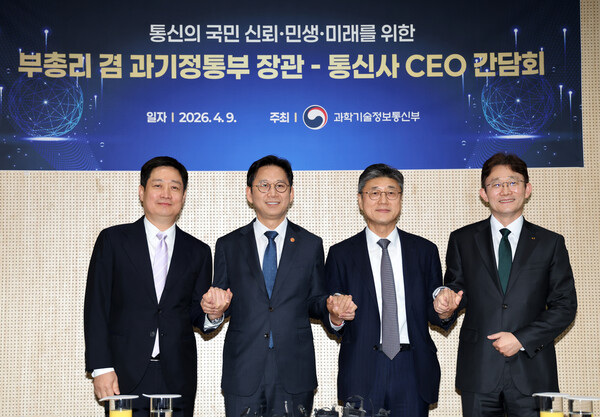
South Korea's Ministry of Science and ICT held a meeting with the heads of the three mobile carriers and asked for an overhaul of security policy and guarantees of basic communications rights.
The ministry said on April 9 that Vice Prime Minister Baek Gyeong-hun (배경훈) and the heads of SK Telecom, KT and LG Uplus discussed ways to restore public trust in the telecommunications industry at the Korea Federation of Science and Technology Societies building in Seoul.
All three attended: Jung Jae-heon (정재헌), CEO of SKT; Park Yoon-young (박윤영), CEO of KT; and Hong Beom-sik (홍범식), CEO of LG Uplus. It was the first such meeting with the heads of the three carriers since Baek took office. Based on the discussions, the three carrier chiefs issued a joint declaration to formalise their commitment to reforms.
Baek: Carriers' security responsibility is clear, must answer with sweeping reforms
The telecoms industry is facing an urgent need to restore public trust after a series of hacking incidents. In the first half of last year, SKT was hit by a USIM hacking incident. In the second half, KT had an unauthorised small-value payment incident. More recently, LG Uplus faced controversy over exposure of subscriber identity numbers (IMSI).
In opening remarks, Baek said both the industry and the public suffered difficulties as the telecoms sector experienced successive hacking incidents.
He said the hacking incidents last year made carriers' responsibilities and roles clearer. He said it was time to respond not with simple reflection but with reforms on a scale of a complete overhaul that the public can feel. He added that the industry should contribute to people's livelihoods, including by guaranteeing basic communications rights for all citizens, and should also lead an AI-based society through active investment.
The meeting focused on strengthening security as a key agenda item to restore trust in the industry. Baek again stressed the importance of information security and called for responses on the level of a fundamental shift in the security paradigm and efforts to prevent a recurrence. He also asked for cooperation in setting up counselling and damage reporting and intake systems to support digitally vulnerable groups in the event of security incidents under the Digital Inclusion Act, which takes effect in April next year.
All three carriers pledged to strengthen security and build a safe network environment. Jung said, "We will deliver a new 모습을 through a complete overhaul and work so that the three carriers can take the lead in a rapidly changing future era," and added, "We will also devote our capabilities to the AI infrastructure industry."
Park said, "After taking office, I first visited information security and network sites to check whether there were any empty teams," and added, "A safe network is KT's reason for being and a fundamental value that cannot be compromised, so we will strengthen the fundamentals and do everything to restore trust."
Hong said, "We will make security, quality and safety our top priority and do our best to reinforce them," and added, "In particular, we will thoroughly check security from the basics and create an environment in which customers can use services with peace of mind."
Three mobile carriers to cooperate on basic communications rights policy, step up AI telecom network investment
The three carriers will actively cooperate with the government's basic communications rights policy. They agreed to swiftly push to expand voice and text services for older people and launch bundled plans including 5G plans in the 20,000 won range. They also listed key tasks including upgrading subway WiFi in a transition from LTE to 5G and improving communications quality on high-speed rail, to raise service quality in public transport. They also discussed cooperation on developing nationwide services based on proprietary AI models using carrier platforms.
Jung said, "We will deliver a new 모습을 through a complete overhaul and work so that the three carriers can take the lead in a rapidly changing future era," and added, "We will also devote our capabilities to the AI infrastructure industry."
Park said, "After taking office, I first visited information security and network sites to check whether there were any empty teams," and added, "A safe network is KT's reason for being and a fundamental value that cannot be compromised, so we will strengthen the fundamentals and do everything to restore trust."
The ministry said it will push to introduce a service that gives priority to emergency rescue communications for the National Fire Agency over commercial networks to strengthen disaster-response communications systems. Baek asked for the three carriers' cooperation and said the government will actively support research and development and large-scale demonstration projects to secure a wide technology gap in AI networks.
Baek also urged the three carriers to expand investment not only in AI data but also in next-generation communications networks that form the foundation for building an AI highway. He also asked them to check the possibility of raw-material supply and supply-chain instability stemming from recent changes in Middle East circumstances, and urged thorough responses to ensure no disruption in providing telecom services.
Immediately after the meeting, the three carriers issued a joint declaration reflecting key discussions. They said they will work to strengthen a reliable security system, expand communications benefits that people can feel, and increase investment in AI networks. The three carriers said, "We promise to faithfully implement the declaration to add reassurance to people's daily lives, make livelihoods more affluent, and add new opportunities for the future."
The ministry said it will operate a quarterly consultative body of the three carriers' CEOs. It will share future information-protection measures based on discussions by each company's chief information security officer.
Baek said, "We will institutionalise the meetings so they do not end as one-off discussions and strengthen public-private cooperation so that results people can feel can be implemented without disruption," and added, "I hope the telecommunications industry can play a pivotal role in contributing to stabilising livelihoods and strengthening global leadership in the AI era."
 Jin-ho Lee
jhlee26@d-today.co.kr
Jin-ho Lee
jhlee26@d-today.co.kr