
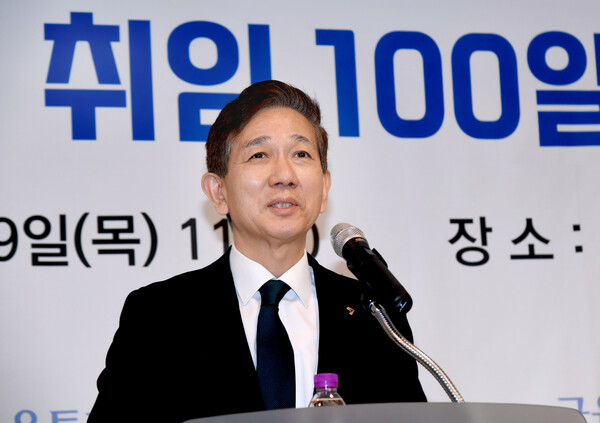
Hwang Seong-yeop (황성엽), head of the Korea Financial Investment Association, unveiled a 10-year blueprint for South Korea’s capital markets and five priority tasks to mark his 100th day in office. The plan aims to improve the market’s fundamentals, focusing on support for innovative companies, retirement pension reform, expansion of the wealth management market, digital finance innovation and stronger global competitiveness.
At a press briefing held in Yeouido, Seoul on Wednesday, Hwang assessed that now is a moment for the country’s capital markets to make a step-up. He stressed he would prepare a long-term policy roadmap centered on pensions, taxes, wealth management and digital innovation.
On support for the growth of innovative companies, he said preparations are in the final stage to introduce a business development company (BDC) that invests more than 60 percent of its assets in venture and innovative firms.
He also presented tasks including strengthening operations of integrated managed accounts (IMA), reinforcing large brokerages’ corporate finance functions, and improving net capital ratio (NCR) regulations to expand smaller firms’ supply of venture capital. He also cited making calculations of risk-weighted assets (RWA) more realistic.
He also expressed expectations for the National Growth Fund and the National Participation Fund. He said he sees sufficient potential for them to take hold in the market if government fiscal support and tax benefits are provided together. He projected the base for supplying venture capital would grow further if participation in BDCs expands to include securities firms in the future.
He also put retirement pension reform on the agenda. He pointed to the defined benefit (DB)-centered structure and a concentration of default option reserves in stable products as reasons for low returns. He said he would review strengthening the effectiveness of default options and the possible introduction of an opt-out method.
On a fund-type retirement pension, he said it could be a way to improve returns, but issues such as compatibility with the existing contract-based system, governance and the operating entity must be considered together. On the possibility of the National Pension Service entering further, he said public and private pensions have different characteristics, so the role of the private sector should be expanded first.
To expand the wealth management market, he said he would actively propose raising contribution limits for individual savings accounts (ISA), expanding tax-exempt limits and introducing junior ISAs. He said he would also pursue institutionalising separate taxation for dividend income and revitalising the trust market.
In digital finance, he said discussions are continuing on supporting on-the-ground implementation of the token securities bill passed in January and on introducing a digital asset futures ETF. On strengthening global competitiveness, he cited inclusion of government bonds in the World Government Bond Index (WGBI) and inclusion in MSCI developed market indexes as key tasks.
On WGBI inclusion in particular, he mentioned the possibility of passive fund inflows of up to about 90 trillion won by November. He said work is under way to introduce an international integrated trading account, improve procedures for verifying the real names of foreign corporations, and enhance an English-language bond information center to improve convenience for foreign investors.
He also listed risk management and investor protection as the final task. He said he would support an orderly soft landing for real estate project financing (PF), support the settlement of accountability frameworks at smaller firms, and expand life-cycle investor education that includes digital assets and high-risk financial products.
He also laid out positions on recent industry issues. He said extending stock trading hours at the exchange is a task that will be hard to avoid given market trends, and he explained that K-OTC is conducting screening and ex-post monitoring to prevent it from becoming a venue for indiscriminate trading of delisted companies.
On controversy over exaggerated advertising for ETFs, he said a review is needed at the level of self-regulation, but institutional changes should be made carefully. He added that the introduction of single-stock leveraged ETFs based on Samsung Electronics and SK Hynix should be reviewed as a way to expand investor choice.
 Oh Sang-yeop
yub@d-today.co.kr
Oh Sang-yeop
yub@d-today.co.kr