
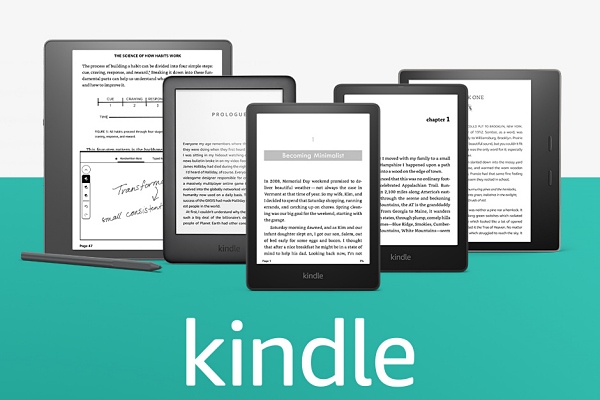
Amazon will end support on May 20 for older Kindle models released before 2012. Users will still be able to read e-books they have already downloaded, but the ability to buy or download new books will be cut off.
Tech outlet TechRadar reported that after the step was announced to users by email, backlash has been spreading mainly through online communities.
Models affected include the first- and second-generation Kindle, Kindle DX and DX Graphite, Kindle Keyboard, Kindle 4 and 5, Kindle Touch, and the first-generation Kindle Paperwhite. That effectively limits most early Kindle devices to the level of offline storage devices.
Users have continued to complain about why the core functions of devices that still work normally should be cut off. One user asked, "Why do I have to change something so simple that still works well?"
The reaction reflects the nature of e-readers. Users argue that unlike smartphones or PCs, they do not require periodic high-performance hardware, and as devices dedicated to a single purpose of reading, they remain usable for a long time without major inconvenience. Several users say it is enough to preserve the basic reading experience rather than add new features. One user said, "This is just a device for reading text, and there is no need to turn it into a brick for money," and another wrote, "If a device is not broken and already has the functions you need, you should not be forced to upgrade."
The move blocks a direct path to receiving new content within Amazon's ecosystem, but it does not stop all ways of using the devices. Users see sideloading e-book files from outside Amazon as a workaround. A common method is to send files or EPUBs to a Kindle-specific email address to add them to the device library. Some users said they have moved files directly using a cable and a laptop.
Still, it is unclear whether sideloading will continue to work in the same way. For now, the end of support has not led to steps that also block external file transfers, but concern is growing among users about whether the method will keep working after May 20.
Concerns about electronic waste have also been raised. Critics say companies are shortening the life of properly working products by ending software support, even though older devices are not broken and simply become less useful.
Amazon's decision has become a case that again asks how far support for older devices should be maintained in the e-reader market. User resentment is stronger because for products where stability, battery life and readability matter more than performance, the end of support can be seen as pressure to replace devices. In this situation, the practical choices are narrowing to continuing to read books already stored or using sideloading through routes outside Amazon.
 Jinju Hong (홍진주)
hongjj@d-today.co.kr
Jinju Hong (홍진주)
hongjj@d-today.co.kr