
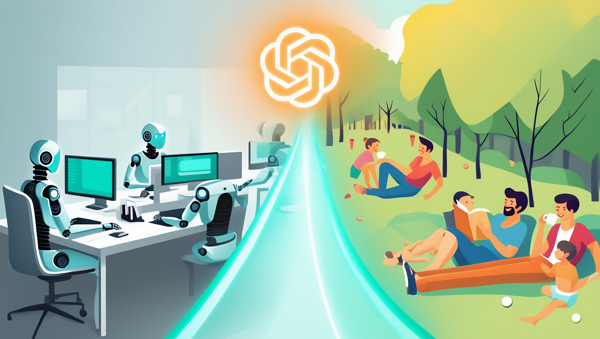
[DigitalToday reporter Hong Kyung-min (홍경민), intern] OpenAI has presented a sweeping blueprint for national industrial policy centered on strong government intervention, an overhaul of the tax system and the introduction of a four-day workweek to respond to rapid social change driven by the spread of artificial intelligence technology.
On April 7 local time, IT outlet TechRadar reported that OpenAI released an industrial policy report titled "Industrial Policy for the Intelligence Age" and argued that democratic societies should jointly design their economic future in preparation for the transition to a superintelligence era.
Based on an analysis of current policy directions, OpenAI explained that the moment calls for government oversight and intervention, moving away from the longstanding practice of technology companies seeking deregulation. It warned that ambitious national industrial policy must underpin efforts for superintelligence to benefit everyone, and that neglect could lead to serious side effects such as technology misuse or threats to democracy.
Against this backdrop, the most urgent immediate tasks were cited as job losses and the risk of collapse in certain industries. OpenAI said it trusts that the benefits brought by technological progress will outweigh the challenges, but stressed that society must face labour-market turmoil as entire industries are reshaped. As a practical solution, it proposed expanding the "care and connection economy"—including childcare, elder care, education, healthcare and community services—as new career paths for workers. This is interpreted as a strategic judgment to maintain job quality by strengthening human domains that machines find hard to replace.
Along with strategies to sustain employment, it also put forward ways to redefine the value of labour. OpenAI presented a pilot plan for a "32-hour, four-day workweek" without wage cuts and said governments and companies should work together to shorten working hours on the condition that productivity and service levels are maintained. The idea is to return the gains from efficiency improvements delivered by AI adoption to workers as tangible additional time.
It added that if the pilot succeeds, it could be shifted into a permanent system or converted into an expansion of paid leave. Such a vision, it noted, comes with the precondition that productivity gains should not lead to companies monopolising profits but must translate into real wage increases and welfare.
As a measure to address imbalances in the broader economic structure, it also raised the need for fundamental reform of taxation and distribution. As AI replaces human labour, an existing revenue system reliant on labour income will inevitably face limits, and more of the tax burden should be placed on capital and companies that benefit from automation.
It also proposed social redistribution models, including creating a "public wealth fund" that would manage proceeds jointly and return them to citizens so that vast wealth created through AI cannot be monopolised by a small number of companies. This is a concrete distribution roadmap aimed at a structure in which the entire population shares the gains from technology.
In conclusion, OpenAI defined AI in the proposal as infrastructure that supports the national economy and public services overall, beyond software alone. It also made clear that while AI technology has ample potential to reshape the economic structure in a better direction, neglect could bring about an extreme concentration of wealth and power.
It is seen as an unusual move for a company that directly develops the technology to be the first to propose regulation, taxation and redistribution measures. Whether political circles, historically weak at long-term planning, can accept such radical policy proposals and design a new economic system is expected to become a key issue in the coming AI era.
 Hong Kyung-min
hongm@d-today.co.kr
Hong Kyung-min
hongm@d-today.co.kr