
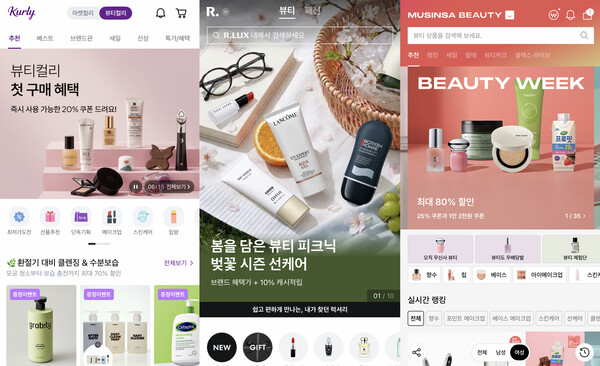
[DigitalToday reporter Shin-hye Ahn (안신혜)] South Korean e-commerce companies are stepping up efforts to expand their beauty categories. They are tapping membership users and logistics systems built through their existing businesses and picking beauty as a new growth engine.
According to the industry, major e-commerce platforms including Coupang, Kurly and Musinsa are expanding their business scope into beauty from their core categories of food, fashion and daily necessities. Early movers are growing scale by bringing in luxury and indie beauty brands in succession. Latecomers are strengthening their business foundations by expanding offline touchpoints.
E-commerce platforms are focusing on beauty because they can use existing infrastructure. Platforms with accumulated logistics capabilities such as fulfilment and quick commerce, along with membership customers, can relatively reduce the burden of initial investment.
Kurly and Coupang are representative e-commerce companies that have entered the beauty business by using memberships and their own fulfilment infrastructure. Kurly launched Beauty Kurly on its platform in November 2022, and Coupang launched Alux in October 2024. Both operate them as vertical platforms, a service focused on a specific field, separate from their existing core businesses. They are also strengthening the lock-in effect of the two vertical platforms through subscriber benefits centred on each company’s members, Kurly Members and the Wow Membership.
In Kurly’s case, it has positioned its beauty business as a key driver to secure its main customer base and potential customers. The year 2022 was also when Kurly entered the 2 trillion won sales club by posting annual revenue of 2.04 trillion won. In particular, products in Kurly’s beauty category have an average selling price about 3 times higher than Market Kurly, raising profit per order by shipping them together with Market Kurly products. Its strategy is to maximise the combined shipping effect by running Market Kurly and Beauty Kurly simultaneously within the Kurly app.
Coupang has launched a separate standalone app and is growing Alux into a luxury beauty platform. At the time of its launch, it operated by directly purchasing luxury beauty brands including Estee Lauder, Sulwhasoo, Biotherm and The History of Whoo. Coupang has also recently expanded Alux’s product range to include more high-priced and premium brands, focusing on broadening its scope. At the end of last month, it added niche fragrance brands including Frederic Malle and Kilian Paris.
Major fashion platforms such as Musinsa, Zigzag and Ably also see beauty as a core area for expansion. As Musinsa accelerates the expansion of offline stores following growth of its online platform, it is using its online and offline channels as the foundation to broaden its beauty business, Musinsa Beauty. Musinsa has also begun expanding its beauty organisation, including moving to hire this month for beauty business expansion.
According to Musinsa, Musinsa Beauty’s transaction volume last year grew more than 50 percent from a year earlier. Musinsa plans to set up a large-scale beauty zone by bringing in more than 700 brands within Musinsa Mega Store Seongsu this month. In the second half, it will open standalone beauty select shops in key commercial districts such as Seongsu and Hongdae in Seoul to target the offline market.
Zigzag’s beauty category has also been growing since its launch in 2022. The number of beauty brands on Zigzag increased more than 10-fold, to about 2,000 as of the end of 2024 from about 200 in 2022. According to Zigzag, beauty transaction volume rose 133 percent in 2024 from the same period a year earlier, and increased about 50 percent last year from a year earlier.
Zigzag plans to expand "Zigzag Only", which secures exclusive products through collaboration with beauty brands. According to Zigzag, transaction volume for most brands that took part in exclusive Zigzag Only launches grew by up to more than 37 times. Its strategy is to boost competitiveness by securing more exclusive and pre-launch products sold only on Zigzag.
A Zigzag official said, "Beauty competition among platforms has recently intensified," and added, "We are securing diverse selections that fit the needs of our main customer base and enhancing Zigzag’s differentiation with exclusive and pre-launch products on Zigzag."
As growth in the beauty category continues, more companies are also launching private labels, or PB. Musinsa operates its own beauty brands Musinsa Standard Beauty, Oddtype, Wichy and Notherub, and transaction volume for its PB beauty brands last year grew 120 percent from a year earlier. Kurly secured personnel for a PB launch or proceeded with trademark applications late last year.
Competition in the beauty business is expected to intensify, though. The industry believes that because existing brands are already established in the beauty market, it will not be easy for e-commerce companies entering as latecomers to secure competitiveness. The online beauty segment also lacks a firm No. 1, making market analysis difficult.
An official at an e-commerce company that operates a beauty category said, "In the beauty market, demand is being confirmed in large numbers, so the number of competing companies continues to increase," adding, "Many companies are also reluctant to disclose related figures because the period of e-commerce entry into the beauty business is not long." The official said cut-throat competition to secure consumers, including offline stores and discount benefits, is also expected for future growth in the beauty business.
 Shin-hye Ahn
doubletap@d-today.co.kr
Shin-hye Ahn
doubletap@d-today.co.kr