
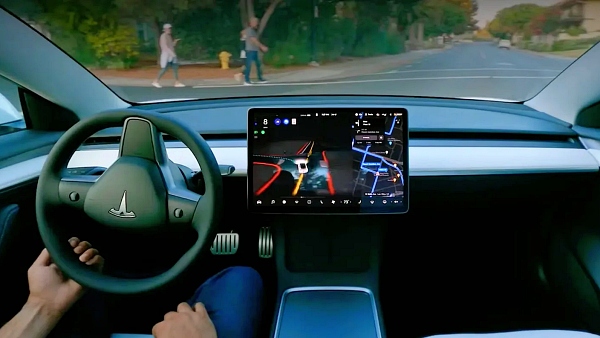
[Digital Today reporter Jinju Hong (홍진주)] An analysis says Tesla’s supervised Full Self-Driving (FSD) driver-assistance system is widening perceived performance gaps depending on the hardware generation. Electric vehicle outlet Cleantechnica compared differences between older HW3-based vehicles and newer HW4-based vehicles through long-term use and test drives on April 6 local time.
According to the report, the owner of a 2019 Model 3 (HW3) paid an additional $6,000 at the time to buy FSD. Early FSD assisted driving on highways from on-ramp to off-ramp, adjusted speed to the vehicle ahead, and stopped at traffic signals and stop zones. After more than 6 years of updates, it became capable of navigation-based city driving, and developed to the stage of moving to regular roads and parking lots after a destination is entered. The user rated steering performance as "better than I drive."
But the latest version running on HW3 (V12.6.4) still has limits. The vehicle could not drive itself out of a garage or back in. Its function to find an empty spot and park in a large parking lot fell short of expectations, and in some intersections it chose the wrong lane. The report also pointed to issues that could be directly linked to safety, such as failing to slow down in school zones and inadequate response to road dips.
By contrast, HW4 installed in new cars from 2024 supports FSD V14 based on stronger computing performance and high-resolution cameras. The writer who took part in the test drive rated the HW4-based vehicle as "100 percent automated in many situations, from the departure to the arrival stage." Parking-space search and automatic parking and pull-out functions were noticeably improved, and the vehicle call function through Summon was also described as more stable.
In an actual test drive, it carried out a highway exit on a congested road without difficulty, and it was seen choosing the correct lane at intersections where errors were frequent in older versions. After arriving at the destination, it completed reverse parking without additional operation. Still, the automatic garage entry and exit success rate was low in narrow garage environments, and some UI operations were also criticised as less intuitive.
Attention is focusing on whether HW3 vehicles will be offered a 'V14-Lite'. Some have raised the possibility of support within the second quarter, but Tesla has not yet issued an official position. The writer said HW3 hardware still has sufficient performance and looked for room for software improvements, but said that if support is halted it could become a factor encouraging replacement with a new car.
The comparison is drawing attention because it shows Tesla FSD has entered a stage where the experience itself differs by hardware generation, beyond simple software updates. It also said that as it gets closer to full self-driving, completeness in the final segments such as departure and parking is emerging as a key competitive strength.
 Jinju Hong
hongjj@d-today.co.kr
Jinju Hong
hongjj@d-today.co.kr