
With high oil prices, a weak won and high inflation converging, South Korea's economy is facing a complex crisis. The won-dollar exchange rate is nearing 1,540 won and petroleum product prices have jumped about 10 percent from a year earlier, quickly spreading inflation pressure. Some forecasts say consumer inflation could approach 3 percent after April.
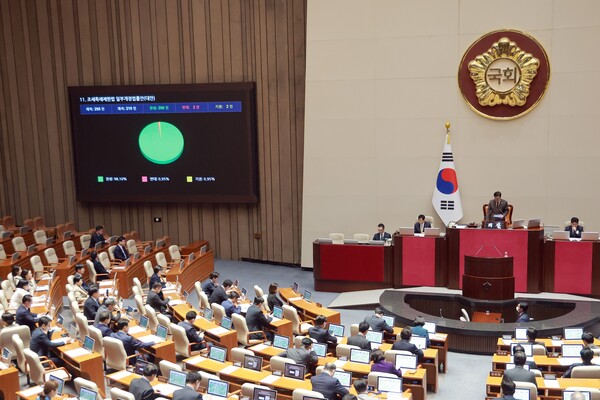
The Bank of Korea is widely expected to keep its policy rate unchanged at this month's monetary policy meeting. If high oil prices and the weak won persist, the possibility of a rate hike in the second half cannot be ruled out. The government and parliament passed three foreign-exchange stability bills with bipartisan agreement to defend the exchange rate. They also introduced incentives that exempt up to 100 percent of capital gains tax if proceeds from selling overseas stocks are reinvested in the domestic stock market, through RIA accounts, by the end of May.
Warren Buffett warned that the banking system may look solid on the surface but could become vulnerable if financial panic spreads, adding to worries about global financial instability. With macroeconomic uncertainty rising on all sides, the direction of monetary policy and the government's market-stabilisation message are more important than ever.
• High oil prices, weak won and inflation put monetary policy at a critical juncture • Parliament passes three FX stability bills; up to 100 percent capital gains tax exemption if returning to local stocks by May • FX rate nears 1,540 won; Bank of Korea governor nominee says there is no major concern • Warren Buffett says the banking system is strong yet vulnerable, warning of contagious financial panic
Financial authorities are further tightening total household debt controls, putting what is described as a "double squeeze" across lending and the broader property market. With the overall management stance becoming clearer, including cutting the household loan growth target to 1.5 percent, concerns are also growing about a pullback in lending and a market slowdown.
In capital markets, authorities are moving to diversify derivatives and overhaul rules for digital assets, alongside broader structural changes. The domestic derivatives market has stagnated, and there are signs of a shift to overseas markets and coin markets, prompting criticism of weakening competitiveness.
The Financial Supervisory Service has urged stronger IT internal controls, focusing on internet banks, and again stressed disclosure discipline on insider trading as it intensifies oversight. As tighter lending rules, market制度 reforms and stronger internal controls proceed at the same time, pressure for structural change is building across the financial industry.
• Tightening total household debt further, putting a "double squeeze" on lending and property markets • Authorities cut household loan growth target to 1.5 percent • Authorities: pushing diversification of derivatives, reviewing overhaul of digital asset制度 • South Korea's derivatives market at 30 years: "moving to overseas markets and coin markets" • FSS urges stronger IT internal controls at internet banks to prevent repeat system incidents • FSS issues insider trading disclosure alert: "return profits if you sold shares and bought again within six months"
In capital markets, deeper global linkages and shifts in industry competition are unfolding at the same time. Expectations are rising for inflows of mainland Chinese funds as the Korea Exchange pushes to develop joint indices. Delays in approvals for short-term promissory notes and the expansion of the RIA market are highlighting widening gaps among brokerage firms. As funding concentrates further among large firms, concerns are also being raised about weakening positions for small and mid-sized firms.
• Korea Exchange to develop joint indices with Hang Seng Indexes; "expect inflows of mainland Chinese funds" • The market for brokerage-issued promissory notes is growing, but approvals for Samsung and Meritz remain unclear • One week after RIA account launches, concerns small and mid-sized firms will be sidelined amid concentration in large firms
Other key moves in finance and fintech are summarised below.
KB Kookmin Bank launched a Korea-Indonesia QR payment service as it moved to expand overseas payment infrastructure. Shinhan Financial Group expanded cooperation with Visa into future finance areas such as AX and digital assets. Hana Financial Group introduced the "One Pick" account and card targeting minors as it sought to broaden its customer base. Woori Bank moved to convert idle space in branches into a "shared growth platform" as it tried to build a community-based finance model.
• KB Kookmin Bank launches Korea-Indonesia QR payment service • Shinhan Financial expands cooperation with Visa in future finance areas such as AX and digital assets • Hana Financial launches "One Pick" account and card for minors • Woori Bank transforms idle branch space into a "shared growth platform"
KakaoBank opened an official blog to expand content-based customer touchpoints. K-Bank set up a Consumer Protection Committee, the first such move among internet banks, as it sought to strengthen internal controls. Toss Bank partnered with NH Investment & Securities to launch a gold-saving service, expanding investment-linked offerings.
• KakaoBank opens official blog to expand content-based customer touchpoints • K-Bank sets up a Consumer Protection Committee, a first for internet banks • Toss Bank launches a gold-saving service with NH Investment & Securities
Naver Pay upgraded its "Pay Pet" feature to expand character customisation and game content, strengthening services designed to keep users on its platform. NHN KCP took charge of payment infrastructure for Mercedes-Benz, expanding its B2B payments business.
Banksalad posted revenue of 26.0 billion won, up 77 percent from a year earlier, maintaining a trend of improving profitability. Toss recorded annual revenue of 2.7 trillion won, its biggest ever. Hecto Financial entered a "tourist prepaid payment" business with a Japanese partner, moving to expand overseas. Coocon supported paperless issuance of Woori Card's freight welfare card, contributing to greater efficiency in financial infrastructure.
• Naver Pay upgrades "Pay Pet" feature, expanding character customisation and game content • NHN KCP to handle Mercedes-Benz payment infrastructure • Banksalad posts last year's revenue of 26.0 billion won, up 77 percent from a year earlier • Toss posts last year's revenue of 2.7 trillion won, its biggest ever • Hecto Financial enters "tourist prepaid payment" business with a Japanese strategic partner • Coocon supports paperless issuance of Woori Card's freight welfare card
Ho-cheol Shin (신호철), CEO of Kakao Pay Securities, secured a new term and will continue a management strategy centred on "AI and user experience innovation". Welcome Savings Bank launched a co-CEO structure led by Jong-sung Park (박종성) and Dae-hee Son (손대희), moving to full-scale execution of a two-track strategy of AI transformation and strengthening its investment banking business.
• Kakao Pay Securities CEO Ho-cheol Shin confirmed for a new term; "AI and user experience innovation" • Welcome Savings Bank launches co-CEO structure led by Jong-sung Park and Dae-hee Son; two-track strategy of AI transformation and stronger IB
 Ji-young Lee
ljy@d-today.co.kr
Ji-young Lee
ljy@d-today.co.kr