
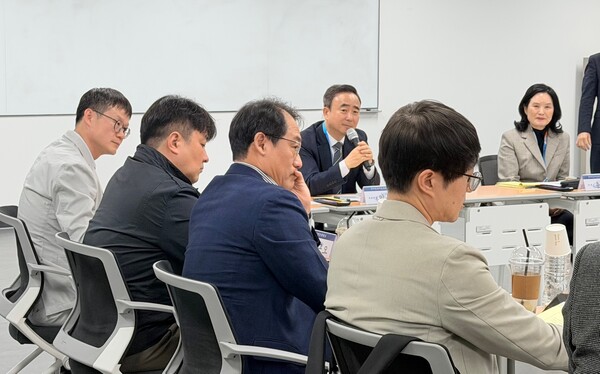
South Korea's National Artificial Intelligence Strategy Committee said on Sunday that Executive Vice Chair Lim Moon-young (임문영) and members of the Regional Special Committee visited Daegu and Ulsan to check implementation of the "AI Action Plan" and review the status of regional AX (AI transformation) industries.
The visit was aimed at checking progress in creating regional hubs under the "5 poles and 3 special zones-based AX innovation belt," a key task in the "Republic of Korea AI Action Plan" announced in February. It was the first schedule since the existing regional task force was elevated to the Regional Special Committee.
In Daegu, the committee visited Suseong Alpha City to review progress in the "Regional Hub AX Innovative Technology Development Project." The committee plans to invest a total of 551 billion won over five years from 2026 to foster Daegu as a global AX research and development and industrial demonstration hub based on AI, robotics and semiconductor convergence.
It then held a meeting with about 10 local companies, including HD Hyundai Robotics and SL. The companies cited on-site difficulties such as initial investment costs and uncertainty over results, a lack of computing resources such as GPUs, restrictions on data use and a shortage of talent.
The committee also visited the Korea Institute for Robot Industry Advancement (KIRIA) to inspect the robot test field and the Advanced Robot Demonstration Support Center. Companies said demonstration projects were unlikely to lead to application on actual production lines due to safety regulations and certification burdens, and the committee said it would support the spread of manufacturing AX by strengthening links between demonstration and commercialisation and improving regulations.
In the afternoon, it visited the construction site of the SK AI data center in the Ulsan Mipo National Industrial Complex. The facility is a hyperscale data center being built through cooperation between SK and Amazon Web Services (AWS) at a scale of about 7 trillion won, and is set to have very large-scale computing infrastructure capable of housing about 60,000 GPUs and a high-efficiency cooling system.
At the site, energy infrastructure issues such as power supply, permits and licensing, and grid connection due to large power demand were raised as key tasks. The committee said, "AI competitiveness ultimately depends on a stable supply of computing resources," and it said it would support data center construction and the spread of an AI expressway by expanding power infrastructure and pursuing institutional improvements in parallel.
Lim said, "The key obstacle to the spread of AX is not technology but adoption risk driven by a lack of confidence in profitability," and added, "We will support public infrastructure so costs and risks can be shared from the demonstration stage, and we will build a system to train AX specialists centred on four major science and technology institutes, including DGIST."
 Seulgi Son
sageson@d-today.co.kr
Seulgi Son
sageson@d-today.co.kr