
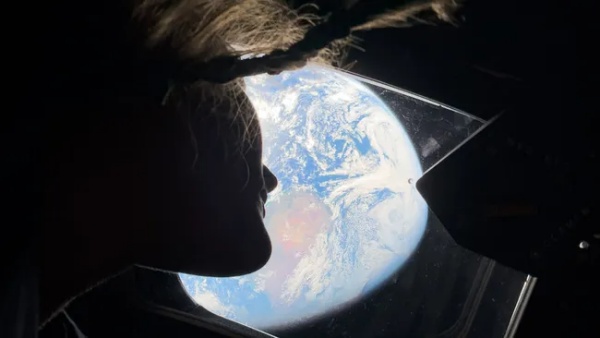
NASA's crewed lunar-orbit flight mission Artemis II is drawing attention as a latest-model smartphone is being used as actual imaging equipment. IT outlets 9to5Mac and TechRadar reported on April 5 that NASA issued each of the mission's four crew members an iPhone 17 Pro Max and allowed its use during the flight.
The move is not simply for convenience, but closer to an experimental deployment of equipment under constrained conditions. NASA blocked both internet connectivity and Bluetooth on the devices and limited them to use for recording. By excluding communications functions, it aimed to secure security and system stability while keeping the focus on photos and video. The iPhones are being operated inside a spacecraft heading to the moon at about 25,000 miles per hour, or about 40,000 km per hour.
Artemis II also differs from previous missions in how it uses smartphones. There have been cases in the past of some consumer electronic devices being taken into space, but this is the first time each crew member has been issued a smartphone and tasked with shooting. That meant the verification process for device stability, material durability and operation in extreme environments was more stringent, reports said. Apple's Ceramic Shield material is also seen as a factor that considers durability in such conditions.
The results are also being released. Photos NASA published show crew members inside the Orion spacecraft looking at Earth. The images featuring Christina Koch and Reid Wiseman were confirmed to have been shot with the iPhone's front camera. Wiseman also released additional photos on his personal social media and wrote, "There are no words."
Images capturing the lunar surface are also drawing attention. The released photos include the Orientale Basin, which cannot be seen from Earth, and media outlets mentioned "it may be the first time the entire basin has been captured by the human eye." They also said the result carries major technical symbolism because it was shot on a smartphone camera.
The iPhone is not the only imaging device. The crew is also using professional equipment including a GoPro Hero 11 and a Nikon D5. Still, the fact that a smartphone, closer to an everyday device, is producing meaningful results even in the space environment suggests the possibility of changes in equipment configurations for future space missions.
In the later stages of the mission, attention is also on whether records will be broken. Orion is expected to travel more than about 400,000 km away from Earth during its return after orbiting the moon, setting the longest-distance record for human crewed flight. Its speed on re-entry is also expected to reach 25,000 miles per hour, or about 40,000 km per hour, making it the fastest crewed re-entry attempt ever.
Experts say the case shows that the boundary between consumer technology and space exploration is gradually blurring, beyond simply introducing an unusual piece of equipment. As smartphones begin to be used as practical tools in space beyond Earth, they say it is becoming more likely that a wider range of commercial technologies will be introduced in future missions.
 Jinju Hong
hongjj@d-today.co.kr
Jinju Hong
hongjj@d-today.co.kr