
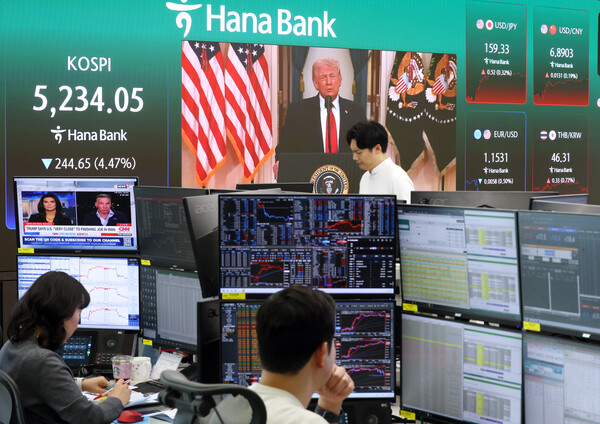
With military tensions between the United States and Iran continuing, South Korea's stock market is expected to seek direction this week depending on how Middle East developments unfold, key economic indicators and corporate earnings releases.
The KOSPI closed on April 3 up 2.74 percent from the previous day at 5,377.30. Intraday volatility increased after U.S. President Donald Trump made hawkish remarks that he could launch a focused attack on Iran within 2 to 3 weeks. The index rebounded after reports said Iran and Oman are discussing protocols for safe passage through the Strait of Hormuz.
Foreign investors in particular turned to net buying in both cash equities and futures in the KOSPI market for the first time in 12 sessions, buying about 1 trillion won. Big semiconductor shares such as Samsung Electronics and SK Hynix, along with shipbuilding, defence and nuclear power-related stocks including Hanwha Ocean, drove the index higher.
Experts predicted that risk appetite over the next 1 to 2 weeks will be determined by the U.S. administration's withdrawal roadmap and the effectiveness of passage through the Strait of Hormuz.
Lee Kyung-min (이경민), a researcher at Daishin Securities, analysed that geopolitics-related tensions stemming from Iran are passing their peak. He added that while cost burdens are inevitable, the worst-case scenario of physical supply disruptions in major raw materials has been avoided.
Despite geopolitical uncertainty, the domestic stock market's valuation appeal remains high. The KOSPI's 12-month forward price-to-earnings ratio has fallen to about 7.6.
Lee Sung-hoon (이성훈), a researcher at Kiwoom Securities, said it is similar to bottom levels seen during the U.S. credit rating downgrade in August 2011 or the U.S.-China trade dispute in October 2018. He said that considering upward revisions to earnings consensus, bargain buying based on fundamentals is effective at this stage.
Semiconductors are cited as the sector most likely to lead the fastest share-price recovery during a market normalisation phase.
Lee Jae-man (이재만), a researcher at Hana Securities, forecast that semiconductors will lead an index rebound if concerns ease over U.S. Federal Reserve rate hikes. He said the KOSPI semiconductor sector's price-to-book ratio is about 1.89, down 22 percent from this year's peak, while its 12-month projected operating profit margin is 47 percent, setting a record high.
A more selective sector strategy is also required depending on moves in global oil prices.
WTI is currently above $110, or about 166,000 won. Analysis said that if oil prices hold around $90, or about 135,000 won, media and capital goods within the S&P 500 and shipbuilding and machinery in the KOSPI would benefit because operating profit margins would rise more.
If oil prices fall to around $80, or about 120,000 won, S&P 500 hardware, transport and pharmaceutical-biotech sectors and KOSPI transport, autos, secondary batteries, steel and chemical sectors are expected to come into focus.
If oil prices stabilise further to around $70, or about 105,000 won, banks, software and pharmaceutical-biotech sectors are expected to post relatively higher price returns.
Market attention is quickly shifting to corporate earnings and key macroeconomic indicators. Major global foreign media also assessed that despite geopolitical risks, the South Korean stock market continues to retain long-term upside potential, supported by growth in artificial intelligence and the semiconductor industry.
Starting with Samsung Electronics' preliminary first-quarter results release on April 7, events scheduled for April 10 include the Bank of Korea's Monetary Policy Committee, the U.S. March consumer price index and China’s March price data.
Brokerages said interpretations differ on inflation levels and developments in the Middle East, which could cause temporary volatility, but the index is expected to recover gradually as fundamentals are confirmed.
Jung Hae-chang (정해창), a researcher at Daishin Securities, predicted that next week will be a turning point determining the market's direction as major macro events cluster, including the U.S. jobs report, inflation data and Federal Open Market Committee minutes. He said this would come as markets move away from geopolitical noise.
 Oh Sang-yup
yub@d-today.co.kr
Oh Sang-yup
yub@d-today.co.kr